[00:00:05] Speaker A: Yoga is stillness.
[00:00:09] Speaker B: Yoga is self awareness.
Yoga is time tested.
Yoga is unity.
[00:00:22] Speaker A: Yoga is secular.
[00:00:26] Speaker B: Yoga is evolution.
Yoga is a never ending practice.
Yoga is.
[00:00:39] Speaker C: Coming back home.
This is Yoga Skushen.
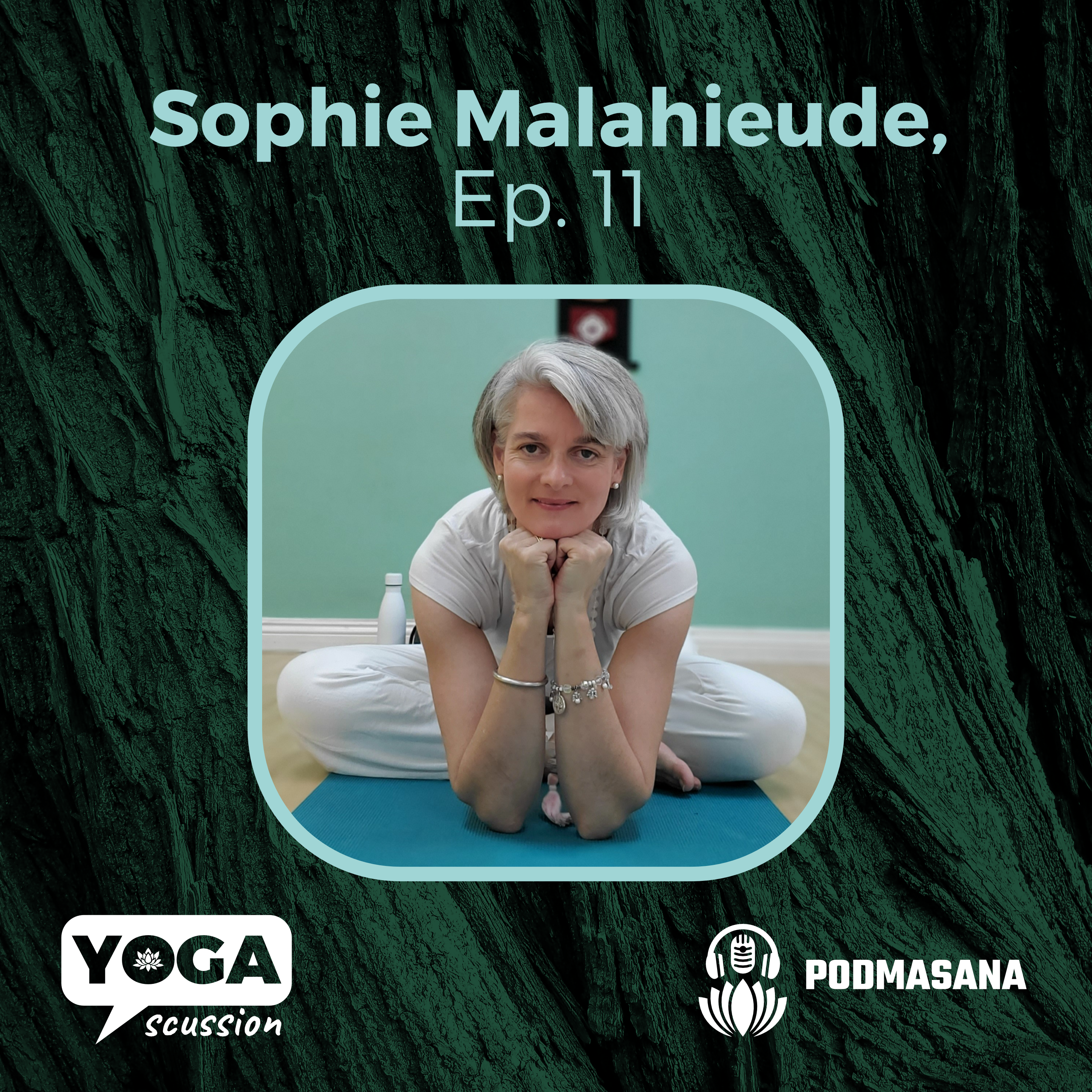
[00:00:45] Speaker B: Well, Gina, we've got a great guest on the show today. We've got Sophie Malayud who is joining us for yoga session today. And Sophie is a yoga teacher and Ayurvedic lifestyle consultant and emotional balance Coach. With over 20 years of practice and study in yoga, Ayurveda, breathwork and mindfulness. She's had an interesting life journey and she says that yoga has been her anchor through grief, motherhood, relocation and deep inner inquiry. And she's now guiding midlife women and reconnecting with themselves through body, breath and awareness. And she also has a new book out called Beyond Emotions. Stop letting emotions control you and start living with love. So I think we're going to have a lot of great stuff to talk about on this yoga discussion.
[00:01:38] Speaker A: Yeah, I'm so excited.
There's just so much to dive into. So I'm excited to have Sophie on.
[00:01:46] Speaker C: Hello.
[00:01:48] Speaker B: Hello, Sophie.
It's so great to see you.
[00:01:52] Speaker C: Great to be with you guys. I was listening to your podcast when I applied to be with you and again this morning. So, yeah, I have the feeling that we are just continuing the conversation.
[00:02:05] Speaker B: Yeah, absolutely. Yeah, absolutely. So what we were hoping, Sophie, is that you could maybe give us a little bit of, you know, your life story because you've got a really interesting life experience, having been grown up in one country, moved to another, moved to another. And if you could just share your life journey with us and how yoga came to it, where it is now, we'd love to have that be the start of the conversation today.
[00:02:31] Speaker C: Yeah, yeah, definitely. You know, the way I encounter yoga for me is very particular. I was still living in France. I was about 25 years old and I heard the word yoga and I was intrigued by the. By the word. So I went to the. To a kind of a community center and the teacher didn't want me in class.
So I said, yeah, but I would like to try. I don't know, I think it's about the mind. And so finally say, okay, so let's come. And the class was difficult for me as it was very slow moving. We were sitting on a chair with a lot of meditation, few movement, but very few. And it was challenging, challenging because I didn't know what was expected from me.
And so at the end of the class, I came to the teacher and said, well, I found it challenging, but I would like to come back. And he said, well, I don't want you to come back.
Well, why? But I say, well, because you are all over the place. And can't you see that the people who are here, there are people who are 50 years old, 60 years old, they are more quiet. It's not a good vibe for you. And so I came back home and I was, you know, very disappointed that because I didn't, I didn't go back. I didn't go back. But funny enough is that few months later or maybe a year later, we moved to Germany and we went to dinner with my husband, colleague who said that I was working during the day, but he was a yoga teacher in the evening and invited me to come to his yoga class. So I explained to him my, you know, my experience. I said, wow, this is so weird. No, just come. Yoga is for everyone, any age, any shape, just come. And so I went and I didn't understand everything because I just moved to Germany. My German was very.
So maybe I was understanding 20% of what he was saying, but nevertheless, I felt home. And I was the entire class, oh my God, I am home.
I was looking for that all my life and I have to share it.
And so I continued to practice yoga and it's 28 years ago.
[00:04:55] Speaker B: Oh, that's great. And just a, A few quick thoughts like I'm, I'm touched to hear that you also maybe didn't have the quote unquote, best experience with your first, like, yoga experience. I very much connect with that. I too, you know, flirted with it and then avoided it for a long period of time. So I'm just very touched to see that it had a way of bringing you back. So.
[00:05:17] Speaker C: Yeah, yeah, yeah. I think it was for me first. And we have to replace that like it was 28 years ago. Is yoga was really a practice to connect body, mind, and without lot emphasis on asana, it was more about how you come back home to yourself. And I think it was part of my personal journey. When you encounter yoga in a way that you have no expectation, then you discover from your heart.
[00:05:49] Speaker B: Yeah. Oof. Like that. Yeah.
[00:05:52] Speaker A: That's so lovely.
[00:05:55] Speaker B: I'm just really curious because some of your work seems to be focusing on the emphasis on trusting the body over the intellect. Right. And it's tying a little bit into, I think, like what the yoga that connected with you. Right. So would you mind maybe speaking a little bit to this concept of trusting or being connected to what is happening inside the body, rather more so than in the headspace of the mind.
[00:06:19] Speaker C: Yes. Yes. Because that's very interesting that I say, well, you know, yoga is not so much about the body, but living your body. So it's kind of completely two different directions, and yet for me, it's connected.
I remember I was practicing yoga for a few months or maybe a year, and I was home and I wanted to reach, you know, on the top of a cabinet to take a glass or whatever it was. And I realized at this moment that instead of working from my mind, just with my willingness to go up and it was too high for me, and I was engaging and contracting all my muscles, let it go and be and from the inside out.
And I really observed at that moment how I was able to reach higher with my entire body.
Not because I was working from my mind and the willingness and my ego telling me, you have to do that, but from a place that let it unfold. And I was raising my hands, grabbing the closet, and I came and I was looking at my.
Whoa. So body, mind, spirit, everything is connected.
And every time we come back right here with this body that is given to us to experience life, we have a different experience.
We have a tendency in our world to compartment.
I don't know if that's a word, but to put in different boxes. The body, the mind, the spirit. You know, the spirit you go to church and then the mind you go to see a doctor, and the body you see to go and the physical therapist. But actually, we are everything. Every time we come back to the body, we understand.
Every time you eat something and you feel off, ask yourself, well, did I eat something that is not good for my body?
Did I eat and I was angry? Did I eat and I was thinking of something else? What is the relationship, what my body's telling me?
Sometimes the body is telling you, well, you know what, you had a cold drink of water with a hot soup, it doesn't mix well. So maybe that's the message of the body. But we don't know it if we don't listen to it.
And the body is everything.
You know, when you are sweating, where you find your muscles tighten, it's all connection that when the body align the spirit, the mind, then everything goes in the right direction.
When we don't listen to the body, the body is going to keep bugging us until we understand.
Yeah. So for me, yeah, yoga was one part of one aspect that helped me to live in the present moment. And where do you live in the present moment? In the body you have.
[00:09:12] Speaker A: Yeah.
While you were speaking, I just got this image of like I could see a body that was in distress. Right. And it was like tight and you know, in distress. And I could see, like it's so much easier for us to welcome ourselves into the body when we are in relationship with it. And like a person in, like we're all like this, you know, a person who's maybe the body's in distress and we're not paying attention. There's not as much ease, there's not as much presence, there's not as much of me here. Like my body may be here, but my mind and my spirit might be trying to find a way to be in the body. But if the body's a really tense under distress kind of environment, like, yeah, it's really easy to disassociate, maybe disconnect.
[00:10:00] Speaker C: Yeah. And you know, I think also that it's difficult, it's easy to disassociate. One of the reason even our modern world is disassociating everything.
For example, if you have a pain in the shoulder, you go and see the doctor and the doctor is going to fix the shoulder. Doesn't make the relation, the relation, sorry, from the shoulder to. Maybe you are compensating because you have something in your hip. And why do you feel your hip? Because you, you had a car accident, an accident. Or maybe you are holding tension and stress in your hip.
And the way that we have disassociated everything, even the body, you know, you have a specialist for the eyes, a specialist for the teeth. But you know, if I don't see what I see in the world, maybe naturally this sense of seeing is shutting down because I don't want to see anymore.
And there is a relationship with that. So in our mode of society, I think that the biggest challenge we have is to come back to the wholeness that we are body, mind and spirit.
[00:11:15] Speaker B: Yeah. And it seems like some of your work, Sophie is touching on, like how emotions like fear, anger and sadness maybe manifest in the body and maybe seeing them like not so much as like health obstacles, so much as maybe signals, maybe inviting like a deeper understanding. Could you maybe speak to that a little bit?
[00:11:37] Speaker C: Yes. And I think that, well, it's the name of the book that is released today, actually.
[00:11:46] Speaker B: Oh, good timing.
[00:11:48] Speaker A: Wonderful.
[00:11:50] Speaker C: And so that's the theme of my book. And this book is born from my life through yoga.
Yoga helped me to reconnect myself with everything. And in the text in yoga, there is not much mention of emotion, it's mention of thought and we stop the fluctuation of the mind. So that's really the following. So in the Yoga Sutra, they are not really talking about emotions. So I studied also Ayurveda. And in Ayurveda they see emotion as energy, but they are not really so clear about emotion. And I was thinking, you know, emotion is such a big element in our life and in our modern society, we avoid them, suppress them, we don't talk about it. And yet they.
It's like prana.
It's an energy.
It's an energy that is trying to communicate with us.
So what is happening is that when you practice and everything in your life, when prana is flowing, then you have a clear mind, you have vitality, you move forward.
When something is off, prana is kind of stuck in one part of your body. And I make a paralysis with emotions. When emotion is completing the cycle, then you have the experience, you learn something.
The energy is flowing, the emotion is flowing. Finish, complete the cycle and it's gone. The thing is that we don't know what to do with the emotion.
So we stuck them, we stuck them in the body.
So everything that is in relationship with love, we keep it on the heart. Everything that when you are fearful, you feel it in your belly.
When it's about guilt or regret as the shoulders, because we put responsibility on our shoulders. And so one bit after the other, we accumulate those emotions that are not processed. So to come back to your question, for me, when I was curious about the emotion, I made a parallel with what I learned in yoga, in Ayurveda and mindfulness, and say, how can I help the emotion to complete the circle, to circulate, to move?
And it's when I came up with explaining in my book everything I practice for myself. I think that. And that's a trigger for me to go beyond the emotion and work on the emotion. Was a little more than nine years ago, my mother passed away. And I was thinking, I'm a yoga teacher, I'm just great, I can manage it. And I didn't manage at all.
[00:14:41] Speaker B: Well, it's a significant life experience, right?
[00:14:44] Speaker C: Yeah. And knowing that my mom was in France and she was really sad that she couldn't see my children as often as she wanted to, I had the guilt of being far away in the last year of her life.
So I have all that on my shoulders.
But four months after my mother passed away, I went to see my yoga in Ayurveda teacher and said, oh yeah, I think I'm doing great, I'm okay. With my mom passing, I'm at peace with that.
And I say to her, well, the only thing is that when I go up the stairs, I don't know why, but I am out of breath. And I just had a regular checkup with the doctor, and I know that there is nothing wrong with my lungs. She said, you know, Sophie, that we hold grief in the chest, don't you?
I said, hmm, Yes, I knew it, but I didn't know it.
You know, I knew it in theory, but I didn't know knew it in my tissue. And it's when I said, okay, so if we come back to the body, if we come back to the emotion, if emotion has our energy, we have to face them to let them circulate, you know?
And then I did many things. I did see a Reiki meister. And then I practiced meditation, breath work. I took a training that is called grief yoga, which was. Whoa, really mind blowing for me, not being afraid of my emotion, you know, because on the top of the thing that on one side, you have love, on the other side, you have fear. And in between, you have all the spectrum of emotion. Sadness, anger, also feelings such as regret, shame.
You can feel humiliated, rejected. You have all the spectrum. But on one side you have love. On the other side, you have fear. We are just afraid. We are even afraid of fear.
And so when we stop and say, okay, I'm just going to let that through.
Move it. So then you remove all the layers. And I understand why I was not facing my emotion when my mother passed away, because the first emotion I had was anger.
And who want to be angry at someone you love? I mean, that's so wrong and yet.
[00:17:14] Speaker B: Yet so common. Maybe.
[00:17:16] Speaker C: Yeah, it's very common. It's very common. And it's what I say. I like to compare emotion as fire. Fire is only fire. It does what he has to do. Fire, burn. It's made to burn that it's Dharma, if you want.
Now, your experience with fire can be a positive experience or a negative experience.
Maybe you warm yourself on the fire, you cook your meal, so that's great. Fire is great. But maybe one day you burn yourself, and so fire is dangerous, so you don't want to go there. Well, that's the same thing with emotions. You know, if you have experienced only love and compassion and so. Well, emotions are great, but emotions, they are not only love. They can be anger, they can be surprise, they can be disgust, they can be fear. And so when we expect and that. And it's hurt, we don't want to go there.
So we are blocking the cycle and the movement of the, of the emotion, the purpose of the emotion, which I believe is for us to grow and to expand.
[00:18:31] Speaker A: Yeah, I was just gonna say, like, emotional intelligence is this phrase that gets thrown around a bunch, you know, and like, there, it's all the time. I mean, so many people in my circles are like, oh, I just. Emotional intelligence. And as you were speaking about all of that, I was getting a couple of threads coming together. One is that like, yeah, we have this idea of emotional, emotional intelligence, but it's often like an intellectual exercise of like an intellectualizing our emotions. And what I hear you saying is that yes, we can have this intellectual knowing of our emotions, but then we have to pull it into the body and, and like, metabolize it through the body. Like, the body has to help us metabolize these emotions. And that's where I think we get this disconnect in modern society, right, because we, we understand emotional intelligence. We understand that emotions are big and, and we can work with them, but we forget their, their physical, right? That like, we do have to do the grieving. We have to feel that in our body. And I think the power of grief. This is just me riffing. My mom died last year or a year and a half ago as, as well. So I hear you with this grief. The power of grief is that sometimes it feels like it will just take over.
Like, if you go into it, it's going to become everything. And what I've learned over the year and a half that I've been grieving my mom is that it comes in like these little waves. And sometimes the waves, like, knock your boat down and you're like bailing water. And then sometimes the wave is like, okay, I got this. I can sail this wave. I can ride this wave. But I think when you practice this in the body, like giving your space, your yourself, time to grieve in your flesh, you know, whether that's crying or wailing or keening or weeping or just laying on the floor or the ground, it gets easier. Like, you get to a point, and I've found myself lately being like, I'm going to be okay. I'm going to be okay. Like, I've made it through these big waves and I know that my body can hold this, and I know that my mind can hold this. And I know that it won't be forever. I mean, it'll always be there.
I don't think grief ever really goes away. It's like we Just get better at being friends with it.
[00:20:54] Speaker C: Yeah, I think that grief, the experience, any experience we have in our life shape us.
So it's not like, okay, I have grief and I continue what I was doing. So no, we transform ourselves through grief, through grieving. My mom, I learned so much about.
I understand. And I understand better my mother for starting and I understand myself better as well. Something you were saying? Yes.
If we come back to the. To the idea that emotion are energy and we leave it in the body. I really believe that because when I was in the process of grieving, there is many way to move the body.
So you can do breathing exercise, strong breathing exercise, you know, like which one?
Kind of a pastrica breathing exercise. But you use also movement. So you are moving the energy, you are moving prana. As prana is moving in your body, the emotion come up and you can face it.
Okay, I feel angry. My mother passed away. Boo, boo, boo.
And so you unfold the story in your mind and you sort it out.
What is the story creation of the ego and what is the truth.
And that is through feeling it in your body. So now if you are not familiar with lot of breathing exercise, dancing, shaking, you know, you put some music on and say, I'm so mad. And you shake it, shake it, shake it. And you let it be.
Not to become numb and not thinking, but to feel it in your body. So to help your body to release the stress it's holding.
And as you start to release and then your body is not so tight, then your prana is moving and it brings clarity. Oh my God, I was mad at my mom, but in reality I was mad at myself.
And then you say, okay, this layer is moving away. What is the next layer? So when we process emotion and also it's part of my book, is that for me there is movement, breathing, meditation, journaling, if you like to journal, self inquiry. And when you do all these different stage, then you gain clarity and ease and love and openness. But it starts with a willingness to face the emotion, which sometimes we are afraid to do.
[00:23:45] Speaker B: Yeah, I think that's a really honest statement, Sophie. And I think like maybe preceding the willingness is that awareness part, right. Where we need to actually be able to be aware of any negative emotions that we may be feeling. And I really appreciated your framework. You were talking about unfolding, right. And the inverse of that might be folding in. Like I have this laundry analogy in my head maybe because I did laundry within the last 48 hours. Right. Where you know, like just the act of you know, folding is essentially tightening or making something smaller or more compressed. And that unfolding allows for something to mate. You can't really see the clothes when they're like in a, in a folded form, you know what I mean? And, and so, you know, we're guilty as yogis, many of us, as appreciating metaphor, right? So I'm just kind of curious, like, how would one who's dealing with like intense negative emotions, whether that's about a situation or some aspect or experience in a relationship, how should they cultivate awareness and then get to that willingness point to do something about it?
[00:24:55] Speaker C: Well, I think the first point is to observe ourselves.
For example, when I started to be more aware of the anger I have in me, I remember. So in breathing you have different phases, right? You have the inhalation, a moment of retention, exhalation, a moment of retention. So two moment of retention.
Sometimes they are very, very short, and if we don't pay attention, we don't observe them, but they are here. And so when you inhale, you have this time of retention.
You have pure clarity and then you exhale.
So the idea is to elongate the retention to gain clarity.
Okay, I'm going to give you a quick example.
When I listened to this yogi who was talking about the breath and anger, he said, well, in this moment of retention, in this moment of pose, you choose how you are to respond instead of reacting.
So if you push me, I push you back. It's a reaction. You push me, you pause, then you respond.
You might decide to push back.
It's not the thing, but you respond.
And so when I got back home and says, there is something that is very clear in me that my children, they were young, they were 4 years old and 8 years old at this time.
And I was angry in the morning and I didn't like to be angry at my children in the morning. It didn't seem right. And I said, well, so I have to think about this anger. So I decided to meditate on my anger. So again, start with a situation, something that is very precise. So I meditated on that anger. And when I said, okay, I'm angry because I'm afraid you are to be late.
So there is no reason, but why would I pressure 4 years old who has no idea of what time is? And so I was like, how overcome I feel always stressed. And I realized in my meditation that I let the meditation unfold, that it's what I lived when I was a child. My mother pushing us because we were Late. We had to drive to school, and she had to two different school to drop us. And then she had to go to.
And I realized, okay, okay, so this anger that I saw my mother, that's her anger. I don't have to inherit that.
So how do I do in my life to stop being angry at my children?
And I decided to wake up 15 minutes earlier and really it solved everything.
And then I was continuing the exploration of anger. So when my children, they were doing something. And I remember. So my youngest, one day he broke a glass. And I really. And I retell that in the book, is that I remember, I look at him, my first impulse would have been, Henry, what did you do?
And I look at him, and he was looking at me with his big eyes and say, okay, Henry, can you leave me five minutes so I can deal with that in five minutes? You come back and, you know, he run into his bedroom five minutes later or a few minutes later. And what I did, I did deep breathing.
He didn't need to break the glass. It's not a big deal. We have to clean it. So I kind of used my breath to slow down. And then he came back and said, henry, I know you didn't want to break the glass. It slipped in your hands. I really understand that. So now we have to clean that together. I'm going to teach you so you can. You cannot hurt yourself.
And that was for me, the day I realized that through my breath, I can manage my emotion on the spot.
So now. And I think that anger is one of the most easy to observe, you know?
So now when I can feel the anger, when you feel angry, what is happening? Maybe you. You become red, maybe your breath is shorter, maybe your heartbeat is faster. So that sign that you can observe in yourself and say, okay, what do I do? Do I choose to be angry and react? Do I choose to pause a moment, inhale, pause, exhale two, three times?
And then if you choose to be angry, you choose to be angry again. It's not about judging emotion.
It's about, is it appropriate right here, right now for me to be angry?
If a child is going to cross the road and there is a car coming, well, I will be angry to grab the child out of the. And it's okay. After, I will explain that they were in danger.
So there is a time for everything. But you choose, you choose, you respond, you respond.
[00:30:05] Speaker B: Yeah. No, I love that. And you know, as Gina, I believe, referred to earlier, it's human to be angry sometimes, right? And I think when you Know, when I find that I get angry, it's usually because I don't have much awareness of my breath. So I appreciate what you were referring to earlier. Right. Because on one hand, this is a profoundly simple framework and lesson. Right. And so we just repeat it.
We just continue to repeat it as yoga teachers or people who are familiar with this. And there's a lot of people who are like, well, if it was that simple, then it would just manifest a solution for the rest of life, you know? And then I'm. I'm wondering if you can speak to this too. Like, even though we know the tools, have we experienced moments where we're like, oh, shoot, I forgot to apply the rule book that I. That I'm aware. Aware of. And that's. That's why this happened.
[00:31:00] Speaker C: Yeah. And there is many reasons for that. I still observe sometimes that I. Honestly, with anger, I'm. I'm very. I observe myself a lot. Regarding anger, it's more with feeling. Like. Like, sometimes I feel hurt, sometimes I feel that people are mean. It's more on the deepest level of appreciation that I might feel anger. You know, I can feel anger, angry. And on the spot I decide I'm just going to say I'm angry and I'm doing it. So it's more choice. Anger, other emotions, they are still raising up. They are still raising up. And sometimes it's hard for me to be, you know, to step.
To be a little detached from the situation. Okay. And even if I understand the idea or the point of view of the other person, I still feel hurt. It's probably because I have something to work on myself.
[00:32:00] Speaker B: Yes. Yes.
We all might.
[00:32:03] Speaker C: Yeah. I think that saying that we know everything and we are acting always on the wonderfully, it's an illusion. We always have. You know, we are a masterpiece and a work in progress all the time.
[00:32:20] Speaker A: Thank you for saying that. Because I feel like so many people have this idea that when you come to yoga, there's an end. There's an end to the practice. There's an end to, like, you're finally illuminated. You're finally enlightened. You're finally, like, able to control all of your emotions. And it's like, no, this is being human. We're going to have reactions.
We might respond a lot, but we might. We're also just going to have reactions because we're humans and we've all got. I read some of your blog posts where you were talking about inherited trauma, and it's like, we've got that and sometimes we don't know what those are until we are reacting. And that's. And then after the reaction is where we get to have that beautiful space of reflection if we can get there. And I think sometimes I just want to throw this out there. I think sometimes our society so moralizes emotions and, and, and actually moralizes not having emotions, right? It's like, oh, you're not an emotional person, so therefore you're more trustworthy than someone who has emotions. And I, sometimes I think the opposite because I think a person who's in tune with their emotions is like, I see my pain, I see my fear, I see my grief. I know what's happening in of myself. I know where my emotions are going, and so I know how to respond. And I think anger is such an acceptable emotion because it's like a big emotion, right? It's like the, the big emotion. And that's what we're going to see most often. Whereas, like, we can have these softer state things of anger that we maybe don't recognize until it's too late or, you know, we're in the big, the big response of that emotion. And I just, just.
Yeah, it's like. I guess what I want listeners to take away is that, like, is, you know, don't moral, don't moralize your emotions. Like, don't say they're bad. Like, anger's there because we have boundaries or we have hurt. And that's how anger tells us. Like, this is a soft place for me. Like, this is where I'm being hurt or this is where my boundary starts or ends. And that's a message in. And it's a, It's a message in the mind, but it's also. It's gonna be felt in the body. Right? Like the body is. The body is the medium. It translates through the mind, the spirit, if you want to be scientific, like the molecules, the hormones, all of that, it's the medium. It's like the paper on which things are drawn. And I really, truly believe emotions are not a problem. Like, they shouldn't be moralized.
Feel your anger. Do it in a way that's constructive. Like, don't hurt people.
[00:35:01] Speaker C: Yeah.
[00:35:02] Speaker A: If you can't, like, you know, like, physically don't hurt people. I know sometimes our words hurt people, but find a way to come back and say sorry when that happens.
[00:35:13] Speaker C: So, you know, again, to come back to.
Everything that I learned through practice of yoga is that we are one, we are energy. And I am connected with you. I am connected with the trees. I am connected with my cat, I am connected with everything right now. If we come back to the concept that we have a tendency to put everything in a box, that's you, that's me.
So I'm right, you're wrong.
What about there is you and me and a situation.
So instead of we face and we oppose each other, we come together to find a solution that work for both of us.
That's a different way of perspective to see life. You know, like you go to the grocery store, and the grocery store, the cashier doesn't smile. You smile at. You say, what is wrong with this person? What did I do?
Well, you know what? Maybe the cashier. I just had a bad day, and it's hard for this person to smile.
So instead of she's against or he's against me. Is that okay? You have a bad day, let give me you an extra smile that I can help you.
And that's different.
It shifts something in the mind that we are all part of this beautiful universe and we are all connected as we want to.
Yeah.
[00:36:49] Speaker A: I love what you said. There. There is me, there is you, and there is the situation. And I think that's. So I want to make a bumper sticker of that or I want to, like, make a sign of that, because it's. It's an invitation into relationship. Even with a stranger, it's an invitation into relationship. And like, in. I don't know what part of the text it's in, but there's.
There's places where we talk about yoga in terms of, like, it's relational. Like, it's relational. Like, you can't just be in a yoga practice that isn't relational in some form because we are all one.
[00:37:25] Speaker C: Yeah. Yeah. You and me.
[00:37:26] Speaker A: The situation. I love it.
[00:37:28] Speaker C: Yeah.
It was something that was a big challenge when I started to practice yoga, because I was.
When I started to practice yoga, I was reading all those philosophy book, and I.
There is. I have it here, the book. It's from Swami Shiva Vivekananda. Swami Vivekananda, who came in the United States and was giving a lot of lecture about what yoga is. So it was not about moving, you know, poses and breathing. It was really about sharing. And it was keeping things that we are all one. And I remember when I was reading those books, I was looking at my friends. They were, do you feel well with me?
And she was completely in another way. I said, well, you know, I don't know. I don't know what it means. I said, well, I would like to feel one with you and one with everyone. But still I feel that I am an individual. So I was struggling a lot, A lot. And over the year, I did different training. And I remember in that particular training with my mentor yoga and Ayurveda teacher, well, she was sharing her energy with us. And it's like I was becoming part of her circle of energy. And when I pass on her knowledge to my own student, it's like I was expanding the energy that I was with. So it's like my. My student, they were also their student. And my teacher became their teacher. And then we were all one in the beginning. Big universe of energy. And now more and more. I feel like that even if sometimes it's challenging to incorporate all people around me or people that think they are not doing great thing, we have all the spark of love inside of us. Even the people who have forgotten it.
[00:39:31] Speaker A: Yeah, I read this book. Gosh, I might. I can't remember which book it was, but they were talking about quantum entanglement. And this. This might be a little bit far, but in the book, they were talking about how, like, all of the particles that exist now existed in the beginning.
And so if we think about quantum entanglement, which, like, two particles, they can take two particles that have been entangled, they can take one to New York and one to Los Angeles, and they can stimulate one. And the one on the other side, the one in New York, will vibrate to the same stimulation as the one in Los Angeles.
And so they were talking about how we're all made up of stardust and all the same compounds that were all together at the beginning. And so if we think of quantum entanglement, we scientifically are all one. We're all quantum entangled. And that just kind of blew my mind because, like, on a spiritual level, I can read philosophy and I can read. I can, like, understand that. But then on the scientific level, it's also like, there's that too.
I don't know if that resonates with you, but I just.
[00:40:37] Speaker C: Completely. Completely. And there is, you know, thinking that, you know, stardust, we are made at the deep level of our body. We are made of the same component that the stars.
I mean, for me, it's kind of. Whoa.
[00:40:56] Speaker A: Yeah.
[00:40:58] Speaker C: And just to come back quickly to the emotion, when we have a strong emotion, such as anger or, you know, something that you feel very frustrated or you feel that there is injustice, I like to, instead of feeling that I am a victim, to put myself back in perspective while I am on the level of Earth and the stars and the universe.
Is it worth it to really wreck my day and thinking that there is no reason to live or, you know, kind of everything is off?
Well, I put in perspective my size in the universe.
I mean, for me, I always come back to that, you know, and sometimes I talk with my husband and I say, well, is it worth for us to be angry and mad for days if we put in perspective our size comparing to the universe?
[00:42:05] Speaker B: Yeah, I love this. And it's a little personal in the sense that it's part of why I continue to teach. Because I'm curious what the two of you think, but it seems like one aspect of modern society is to be very ego oriented and there's actually compensation involved for behaving that way. Right. There's an aspect of the modern economy that incentivizes that behavior.
And so I'm wondering if both of these two concepts can coexist or how we might see these play out maybe in the coming years or decades. Right. How do we wrestle with both the spiritual and scientific reality of us essentially being stardust, with us being incredibly preoccupied with our ego identity and how valuable that ego identity is. I'm curious what either of you might think.
[00:43:07] Speaker C: Well, for me, you get the point here in talking about the ego.
So we all have the mind. Well, to make it very simple, component of the mind there is the ego and the intellect.
We need the ego because the ego help us to move forward to prevent a danger to, you know, the ego is going to tell us when we are hungry and when we need to sleep and when we need to drink.
Because the ego like to protect us and like to be in control.
So the ego perceives life through past experience and memory.
So I come back to my example with the fire. If one day you burn yourself with the fire, your ego, well, you know what, it's very dangerous, blah, blah, blah, so don't go there.
When we acquired the ego, which would benefit every human being on earth, when we quiet the ego, then we have more room to reverse the intellect, which is about discrimination and say, okay, well I know that one day you burn yourself from the fire, but today you are very cold. Maybe it could warm me up. You can try.
And so if practice mindfulness just to be aware. Yes, we have an ego. Everyone has an ego. And even if.
And the ego is not going to go away now, do we want to give our power to the ego or do we want to be true to ourselves and create a better world?
Because at the end of the day, what Is it? We are creating. We want all to be happy at the same time. I can be happy and create happiness around me.
So if we become very aware of the purpose of the ego and yet don't give our power to the ego, then we are going to use more the intellect. The more the way we can discern, the more we can feel and experience.
So, yeah, I mean, it's why I always explain.
I don't know if everyone can really relate to that, but that's the way I see things.
[00:45:29] Speaker B: Oh, sure, sure, sure. No, I could definitely say I'd relate to that.
[00:45:33] Speaker A: I think too. And I can't remember what text again this is in, but there I remember in reading something that it was talking about we can either be enslaved by the ego, or we can take the ego and have it be in service of the self.
And that's where I.
Yeah, and I think that falls in line with what you were saying, Sophie, as well, is that like, we can either be enslaved by it or we can have the intellect to know. Like, oh, this is coming from grasping. This is coming from fear. This is coming from a past memory. This is coming from, you know, an experience that I had.
The ego is a great tool. We cannot get rid of it psychologically. It protects us. It's. That's its job. It keeps us safe. Safe, but out of balance. Brendan, one of your favorite words. Balance.
An out of balance ego.
It will. It will enslave you. It will tell you things that aren't true. It will make you believe things about yourself that aren't true or other people.
And the ego is useful. We need it. We need it to survive, but we have to have it be in service to the self. And I'm saying self with a big S. Higher self. Right. Core self. The self that is the self that is eternal. The self that recognizes, you know, spirit and essential nature in all of us. And I think that's why we have societal ills. Right. Because we are oftentimes a lot of people who are enslaved by the ego end up in leadership roles and in powerful positions because they have used that. The ego is a tool to gather and hoard and, you know, create.
Create those places. Yeah.
[00:47:16] Speaker C: It tilt. And then it's just. We are just driven by the ego.
[00:47:22] Speaker A: Yeah. And you're right, like creation from an ego that is in service to self is more inclusive. It's a space that everyone gets to inhabit. It's a welcoming. It's like here is where you get to be vulnerable and loved and cared for and all your parts are welcome, whether, whether you feel like they're negative or positive because you're. We all have parts of us that we think are negative, but they're just parts of us. They're just parts of us, you know, And I think that an ego in service creates for the whole. An ego out of balance or enslaving creates for the individual.
[00:48:02] Speaker B: I don't know if all that'll fit on a bumper sticker, Gina, but I'd like to be a bumper sticker too.
Yeah, Sophie, I wanted to kind of circle back to some of your work and touch on especially, like, the role Ayurvedic approaches have had in your work because, you know, there's plenty of people who go through a yoga teacher training, and maybe the Ayurveda side isn't incorporated much into their training. And maybe they don't really go into that. You know, it's often referred to as yoga's sister or sibling science.
So could you maybe.
And you have your own Ayurvedic yoga teacher training. And so for someone who has practiced yoga or who has become a yoga teacher, who may be considering becoming a yoga teacher, and they've never really explored Ayurveda, what do you think they're maybe missing out on? Or what could we maybe talk about in terms of the role of Ayurveda in terms of being in touch with nature and what constitutes what we actually are?
[00:49:01] Speaker C: Yes, when I said I was lucky because the first yoga teacher I met, he was also curious about Ayurveda and how I got also interested in Ayurveda. Very simply put, yoga is a methodology for us to become a better person.
Now, Ayurveda, again, very simply put, is knowledge about what we are made of, what we are made of, and on all level, body, mind and spirit.
So Ayurveda is based on five elements. And so life is created by those five elements of earth, water, air, space, and fire. And so when we understand that all those elements that are creating us, for example, there is more, maybe more fire in me, and maybe, Gina, there is more water in you, and maybe for you there is more, I don't know, water. So when we understand that there is is an element that is shaping us, it means that it will influence the way we eat, the way we think, the way we act.
And for me, it goes hand to hand with yoga practice because when I was practicing only yoga, I was keep missing a part because I didn't know exactly what food was very beneficial for me. I didn't Know if my practice, I had to push myself or to slow myself down.
And when I started to study yoga, I realized that, oh my God, I have so much fire in me.
So if I eat too much spices, then I become judgmental, I am angry, I really don't like to be around people.
And so when I was modifying the way I was eating, I was calmer, my mind was more clear, I was able to catch the ego before it becomes out of control.
So I think it's that practicing or at least learning about Ayurveda, as you are practicing yoga, it gives you more tool for self inquiry, more tool to understand who you are and how you can help yourself to be in a state of being more attentive, attentive to yourself, attentive to your life. So Ayurveda, it's about nutrition. Yes, but the yoga practice, the lifestyle. So when you study yoga you understand that for example, deep strong exercise, when you have lot of fire. So if you do, for example kapalabhati, so you have to build more heat in your body.
So if I am in a good day, I feel a little tired, I'm going to do a run round of Kapalabhat in the morning and yay, I'm good to go. But if I am in a stressful situation at home or, or at work and I do Kapalabhati, then I increase the fire in me and I am more angry.
So in Ayurveda we learned that we balance each other with different. So how do you balance fire with more earth element with more water.
So I can go for cooling food like cucumber and cilantro mint.
So I can drink mint tea all day long, do very soothing breathing like citali, right?
[00:52:36] Speaker B: Yep, I like that one.
[00:52:37] Speaker C: Yeah, yeah, because it's very cooling, it cools the body, it's a system and it cools also the mind.
So what I like about, for me, Ayurveda is so complementary to yoga practice because again, if we go, simply put in the reason we go toward yoga is to find inner peace.
But if I do the practice of yoga with inner peace, but I don't realize what is good or not good for me. And I go into a hot yoga class and I push myself because it's good to push yourself. And I go back home and I am angry at the world.
I am missing a point. I am missing a point.
So, and earlier we were talking about anger and I say, well, I know that I have a tendency, I can be angry. But because of practicing yoga in Ayurveda, I know also how to cool myself down. I know that when I'm not in a good mind state, I'm just going to have a mint tea, I'm just going to have rice, I'm just going to have cooling food and I'm going to do Sitali and so I can rebalance myself. So for me, really, even if you are advancing your yoga practice, just learn a little bit about Ayurveda because it will help you to go further into your own practice of yoga.
[00:54:03] Speaker B: Awesome. Thanks Sophie. And like Sophie, your book Beyond Emotions, as you said, I think it's just, just come out. And so I think you, it's like about your reflections on, you know, everything from your journey, teaching yoga, practicing yoga. And, and I'm just wondering is there a thread that's maybe connected through all of that? And then maybe what would you hope that someone takes away from reading that book? Maybe not intellectually, but maybe embodied in a deeper way?
[00:54:40] Speaker C: Yeah, and thank you for asking the question because that's exactly the purpose of the book is that I wrote the book as a self help book.
So there is 22 chapter I think and 22 chapter. At the end of each chapter there is an exercise. It can be a breathing exercise, it can be a movement, it can be journaling, it can be meditation and the unfolding. So I start by explaining what trigger the emotion that trigger for me to write this book which was the passing of my mom and my journey to sort it out, all my emotion and find inner peace.
So I use this story to explain how the book was born. But then I explain all the unfolding of all the emotion and how we can put one layer after the other to go to the bottom of what trigger all those emotions and make peace with it.
And so in the book I explained that we have different options.
So first we have to reveal the emotion through the exercises. Then after, then when we start the self inquiry, if we diminish the ego and the intellect can move on, we can modify, we can modify our memory to.
Because a memory is not only fact, a memory is an interpretation of the fact that.
So it's up to us.
Do I want to remember when my mother, you know, said something to me and it hurt my feeling her emotion or her emotion, what do I do with what I feel?
I cannot change what she said, I cannot change what she was feeling, but I can change the way I respond to it. And so the book is really for the reader to, to unfold this own journey on their own timing I talk also about universal truth. Like, you know, particularly when you have a strong emotion like sadness. You know, people are saying, well, time is going to solve everything.
Well, we always think that we have time, but time is an illusion.
[00:57:07] Speaker B: I've said that myself. And yeah, those are wise words. Those are wise words.
[00:57:12] Speaker C: So the real time that we have is right here, right now.
So do I want to wait and see or do I want to unfold what needs to be unfold?
So, yeah, the book is about self reflection. Encouraging, I hope, but definitely it's a book for anyone.
They practice yoga or they don't practice yoga. Yes, it's based off my background of yoga and Ayurveda and mindfulness. But it's open to everyone who want to sort it out and be, instead of being passive in their emotional life, go beyond that and grow from it. Because at the end I talk about unconditional love.
If we are able to live from a place of unconditional love, how much lighter do we feel?
[00:58:08] Speaker B: Powerful stuff.
[00:58:09] Speaker A: Yeah, that's really beautiful. Last statement.
Yeah, the last thing I want to say is I was reading your blog post on.
There were just some. On inherited traumas, inherited emotions. And you have such beautiful language. Like you wrote, attention becomes available.
We can sense our needs more clearly. We can relate to others with less persistent rejection, and we can engage with life without constantly anticipating threat or disappointment. And basically you were saying, if you do this work, this is what can happen. And I just, it was just, it just hit me in like the softest, softest part of my heart where it was like, when we do this work, we get softer, we get more open, we get more available, not only to ourselves, but to our family, our friends, our animals, nature, strangers. And something else that you wrote that I thought was really beautiful was forgiveness is not forgiveness not as a moral act, but as a natural consequence of clarity. Patterns soften, energy settles, we become less reactive, more present. And wow, that was just really big and beautiful because I think sometimes we think about emotions in a way that that's moralized or, you know, like we need to forgive people in order to be good people, to be good ourselves.
And what you're saying is like, you already are good. You just need to soften. You need to soften into yourself. And that to me speaks volumes about self love. And I'm really excited to read your book.
Thank you.
[00:59:52] Speaker C: Thank you.
[00:59:57] Speaker B: So the last question we've got for you, Sophie, is if you could describe yoga in three words, what would they be?
[01:00:08] Speaker C: Yoga is coming back home.
[01:00:12] Speaker B: Oh, love it.
Hey listener.
Yeah you.
I'm talking to you actually.
If you've been enjoying the show, please consider leaving us a review on your podcast listening platform or giving us a shout
[email protected] or you can also reach out on the socials. We are on Bluesky, Mastodon, Instagram and YouTube.
Sharing a review with others helps a lot.
Thanks for listening and leaving a review.
[01:01:12] Speaker C: Sam.