[00:00:05] Speaker A: Yoga is stillness.
[00:00:09] Speaker B: Yoga is self awareness.
[00:00:13] Speaker A: Yoga is time tested.
[00:00:18] Speaker B: Yoga is unity.
[00:00:22] Speaker A: Yoga is secular.
[00:00:26] Speaker B: Yoga is evolution.
[00:00:30] Speaker A: Yoga is spiritual.
[00:00:34] Speaker B: Yoga is my life.
[00:00:37] Speaker C: Awareness, mindfulness.
This is Yoga Scushion.
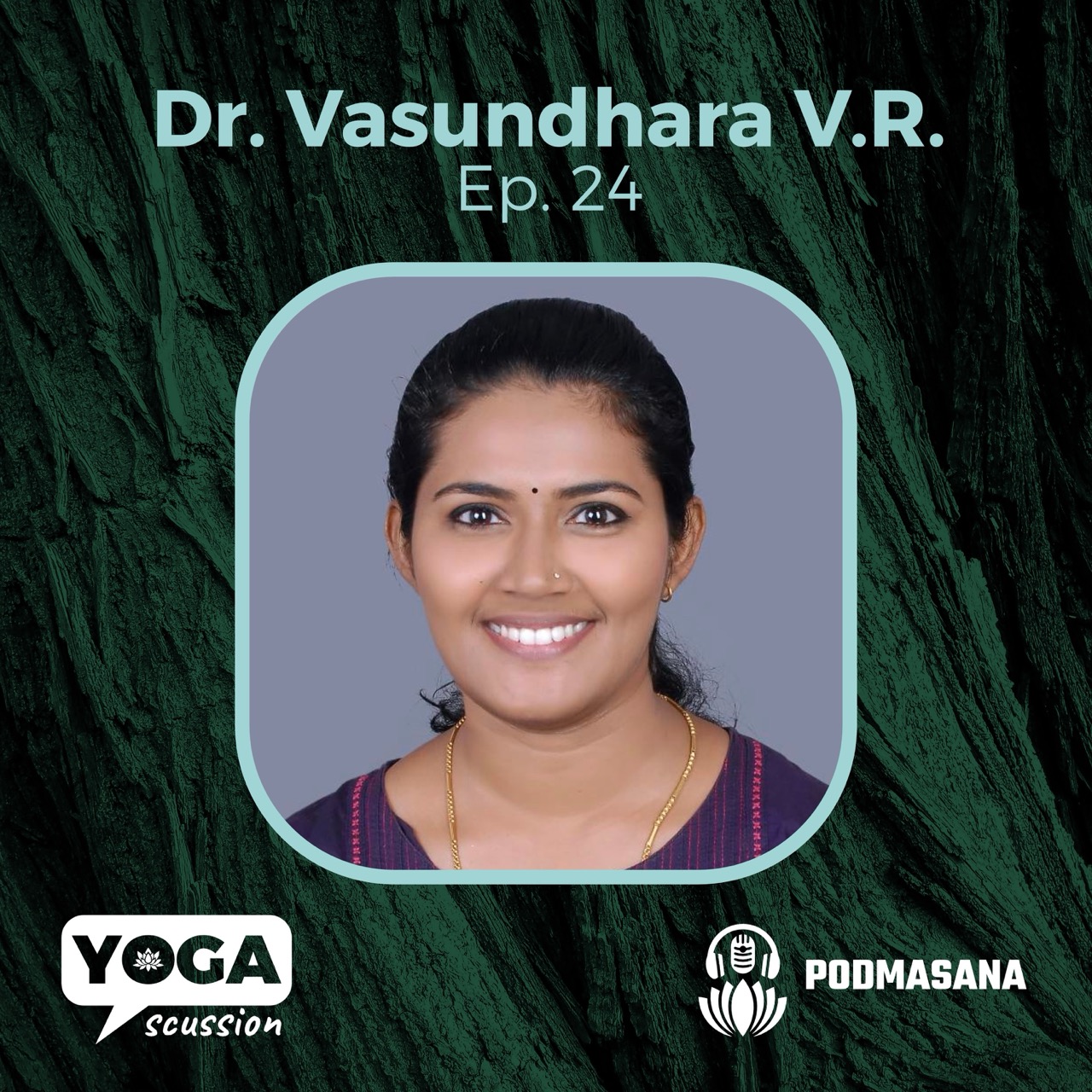
[00:00:45] Speaker B: All right, Gina. Well, today on Yoga Scushion we are warmly welcoming Dr. Vasundra VR Vasundra is a naturopathy physician and yoga therapy specialist based in Kerala, India and she is the medical director at Jeevanam Clinic and head of yoga at Kongi Medical College.
And she blends ancient wisdom with evidence based drugless healing. And she has degrees in naturopathy, psychology and yoga therapy and apparently a Guinness world record for community wellness. So Dr. Vasundra, she empowers patients through lifestyle medicine, functional nutrition and the transformative philosophy of food is medicine that I think a lot of our listeners might be familiar with. So looking forward to yoga discussion with Vasundra.
[00:01:41] Speaker C: Hi. Namaste.
[00:01:42] Speaker B: Namaste Vasundra. So happy to see you and talk to you today. Vasundra, meet Gina and Gina, meet Vasundra.
[00:01:52] Speaker A: Namaste Vasundra.
[00:01:54] Speaker C: Namaste. How are you?
[00:01:57] Speaker A: Good, how are you doing?
[00:02:01] Speaker C: Wait, it's very hot in India.
[00:02:05] Speaker B: Yes, that's what I hear. And, and, and you know, at the time of this recording I might, I'll, I'll be going to India in about a month and a half or so. So I'm going to experience that Indian heat firsthand.
[00:02:18] Speaker C: It's very hot. Like usually it is not that hot but this time it's very hot. I am from Kerala and we don't experience hot. Usually we have lots of wind but this time it is too hot.
[00:02:31] Speaker B: Yes, yes. Yeah. That's the weather reports that I've been hearing. So Vasundra. Yeah. Thank you for joining us for yoga scution and how we normally start things off is we like the guests to just talk a little bit about themselves. You know, how what are some of their earliest yoga memories? Perhaps what yoga means to them and why and how yoga became such a big part of your life. Could you maybe speak to that for a little bit?
[00:03:00] Speaker C: Yes.
Namaste. Myself Dr. Vasundhara, I'm a naturopathy as well as a yoga therapist.
My experience with yoga and my how I was yoga came into my life. So that's what I would like to share. So in India, like when we take natural for the ecos, it's a medical degree, we have to learn yoga also. So it's a part of our medical degree that all the five years we have to learn yoga. So when I was introduced into naturopathy, like it is a new subject similar to Ayurveda here. So and yoga was a completely out of the syllabus in my life because none of my. No one in my family have an experience in yoga. We never heard like that.
So we were introducing you know like it's a residential program. Like our whole four years this was a residential program and we have a disciplined yoga morning sessions in the morning and everything.
And first it was like really fun. Like just like flexibility got lots of stretching and everything. And we were. I was. I was totally not tallies serious about yoga. So I had this issue of my have a respiratory complain and I was having it since a long time. So suddenly it got up and my teachers they. They told that you just follow naturopath naturopathy treatments and we don't take any medicine. And they introduced to me into Pranayam and to my surprise like I was completely able to recover from my lifelong problem problem.
Just it was like I was introduced to both naturopathy as well as the yoga especially the pranayama.
And then I like we started giving it in the our hospital like in our clinic part and everything. And we slowly, slowly we started seeing lots of changes.
And then I finished my.
My program and I just introduced myself into the clinical field and I had this patient. That's why I just turned from yoga to yoga therapy.
Yoga practicing means it makes me disciplined. I. My awareness was like without my knowledge I was totally changing different person. Like the ability to handle the stress like Lady Light which will be a problem for the other people and for me it will be like there's a word called normal phrase. We say you have to before coming into any inclusion you just be in the shoes and see what is that situation.
So that is called Pratipaksha Bhavan. So we will slowly come into your life without your knowledge.
So and it was there, it became a part and parcel of me. And slowly I was introduced to a patient and like everyone I was thinking you can treat everyone with samasanas and some pranayama and I was looking for that. But I was not able to make any difference in his problem. He was suffering from a severe arthritis condition. So I went to my senior doctor and I told that I am sorry I am not able to do. Then he looked at me and he told that we learned yoga for five years. We can't help these people. Who else? So you learned in a therapy way. You have to learn it.
Then slowly I came to understand that there was another perspective of yoga where rather than making it spiritual or your daily practice or something where you there's a therapeutic point of view.
Then I started focusing on that therapeutic point of view. I started exploring myself and I end up in a course under the Dr. Ananda Bhaleki Bhavanani. He's an eminent researcher, yoga researcher from Ondi Cherry and my journey else there. And he introduced me into yoga therapy and that opened a different note.
It's a different look. I thought till that time I was thinking okay, yoga therapy something like a new chapter like anatomy, physiology or something. And I came to know that you know before itself you all know with the familiar term Padanchari. Mahashi Padanjali, founder of Yoga in his book the Padancheri Yoga Sutra we have all the answers.
Yoga is nothing but Anjali Yoga Sutra. You have everything there. Then I just work on it. And I'm still learning yoga therapy and still learning healing. So I choose to be a healer than to be a normal yoga teacher which you see normally who teaches the asanas. I wish and I wish to be a healer. So I'm on my journey in this.
[00:08:08] Speaker B: Yeah, I like how you're even acknowledging that this is an ongoing learning and experiential journey and I really appreciated that.
[00:08:18] Speaker A: So yeah, I love that because sometimes I think we get this idea of like oh, there's an end to, to this practice or this path or this spiritual journey too. Sometimes yoga can be and.
And I just have to remind myself all the time that there's no end because there's always more to learn and there's always more to study and there's always how yoga changes for us as individuals over time.
It's really beautiful.
[00:08:48] Speaker B: Yeah. Vasundra. I was wondering, so you've got this cross disciplinary training and your work is really cross disciplined. So I was curious, how do you integrate all these different fields when working with a patient that might be seeing you?
What does that look like? And do you think that this integrated approach maybe helps people navigate challenges that just a single approach might miss?
[00:09:23] Speaker C: Actually my. With my experience an integrated approach is much more because each person is different body constitution. You're seeing the body constitution part or in the other person. They are different actually. And each system has their own plus and minus. And where I also told you I'm from Kerala. So we have our integration of allopathy like Ayurveda, Mastropati, Homeo and Siddhan.
So these are different kind of and we come into a one umbrella called Ayush. So we work together. So most of the Health system works here. The percentage of the health system works like that. So where you patient is coming to you or person is coming to you, you have, they have a choice.
If you want example, I will tell you if you are coming with an up pain, generally back pain. So you have Ayurveda, you can go for option for medicines. If you want to take medicines, you can either go for homeopathy, Ayurveda or something. And if you want like natural, like a dietary change or something, you can come to naturopathy wherever you are, whichever system you are taking. Yoga act as a club. It's a plug, it's a switch. Like it can be plugged into any, any system, integrated with any system. And it can be integrated with the English allopathy also.
So what I found is rather than giving only one part, you integrate it with some other system.
That person will be in need of medicine. Internal medicine is needed for his current problem. So it works well. What yoga does is it is the efficiency. Sorry, it improves the efficiency of that medicine.
He may be taking tablet or medication for a diabetes for a long time that will cause a stress to that body. When you introduce yoga stress, the cortisol, that body is able to manage the cortisol because cortisol is something which is giving you the stress. So yoga will help you to reduce that stress level.
And that medicine works more efficient in that body than before.
This is what we have done and we have made done so many studies also because we have seen people who are taking the medicine and who are clubbing both yoga and the medication.
Slowly we start with one center and now slowly it has integrated with many other centers. Most of the government centers are working with the integration and the private sectors are also looking into that.
[00:12:16] Speaker B: So fascinating. Yeah.
I'm wondering, Vasundra, do you have or is there a research finding from your work that maybe surprised you or changed your clinical approach?
[00:12:31] Speaker C: Yes, actually I started my research like with infilling. Like I told you I was getting so many of patients where I was introduced to, we all follow a classical kind of yoga. Even in the western part you have Dicham style, Vinyasa yoga, Radha Yoga depends upon the teacher you are learning. But when you come to India, like if you have that, but then also like the where I study, we were engaged in the classical traditional yoga. There is no like different yoga yoga sector. Simply yoga practices and yoga square. You have yoga counseling and everything.
So I was getting n number of people where I was, I was giving them only the practice part. And I Am not getting the result. So I came across one research paper where the research paper was on diabetes and the effect of Shalabhasana on the diabetes. And it showed that the symbol Shalabhasana because when you hear Shalabhasana mainly deep it for the back pain patient and never use Shasana for a diabetic patient. That research paper was from Sriasa. It is on a Shalabasana for the diabetic patient. They showed that when you practice Shalabasana your body will be like able to generate like insulin secretion. And everything can be regulated by that. Then I came. Then I started reading more and more of research papers and I thought that I should involve into more research. And they just joined my infiltrate degree in Yoga.
So where my research start. And I was and thankfully I was introduced into the pregnant women.
So they asked me to do a study on home something.
And they asked me like they will give the here they give gave me the topic.
My guy told me like you will do study on womb candy and on the fetus. This is a baby. The baby in the womb. So I told ma' am like home chanting is otherwise known as.
So I told ma' am then we can do it in the normal person. No can I do it in the free test.
We see it and we started giving it.
The procedure was like this. The mother will be sitting like we took the mother in the second and third trimester. That is from the 22nd week to the 38th week. And they will be like sitting in a comfortable posture with eyes closed. And we ask them to stand first aara then followed by mukara, followed by Makara.
Everything nine rounds repeating. And at the end for nine rounds. So this was going on how the practice we will be assessing the FE heart rate also. And the mother is also asked to experience what this.
So we found it was a remarkable change.
It was like we found when the mother chant Makara is no change. Like we don't feel any much change in the G movement now the fetal heart rate also.
But when you check chant Buara there is a slight deviation in the fetal heart. Like in the like ecg.
Like ECG reading the readings comes in the fetal heart. So slight changes are there. But when you chant Makara at vibration you can literally see the baby like moving, kicking and everything.
And there's a very marvelous change in the reading also. So when we took this to the OG session I told that fetus in highly distressed. That's why showing all these things. But little heart rate was not that High. So it is fetus was not distressed. It was then I came and we have to justify now. So then I Then I ran and read n number of paper. I was not able to get anything. And similarly, we have a music therapy also.
So in the music therapy a man was doing a study on Simradas. So gave me this paper called sound fetus. So it's a research paper. So I got the answer in that paper. That is. It is like we say no. When I'm human, is pregnant husband or the mother of father? We will ask them to talk so the baby will kick like it's supposed. When pregnant husband is coming and talking, the baby kicks. We say that the baby is listening to the father's is responding to the father's sound. Actually, it's not that it is, it is paper is so amazing paper. So what they told her when your mother have an inner sound. Inner sound in the sense that is a heart rate, respiratory weakness.
Like when we are talking. I have all my organs working, right? So that makes some vibration. That is called inner sound. So when the mother is in a very happy mood, whenever good things happen, or when he listened to very good sound. When. When the person whom she like come and have a conversation with you. This inner sound is producing a positive vibration. This vibration moves because it is a wave, right? So it moves into the amniotic fluid. Fluid is a water. So it moves fast through the blood vessels and everything it reaches the canal, like the ear canal, which is the first thing to form in the fetus. So because of that vibration baby is kicking.
So when you produce aara, there is no much change in the vibration.
Little bit of change is whereas makara which produce a high any change in your cell.
That was a study. So this opened a new perspective of research. And this was amazing result which got and.
And I was introducing to a world that this can be taken not only to the people who you see, but not to unborn child also fly. But he's not yet born. Even that baby can feel who is inside you and feel it and get a marvelous change. Why can't we? What was the question I got Then we see the saw the after the delivery. Also we saw the changes like we saw the first four all those things after the delivery of the baby. So it's nothing. But once a baby is born, we'll check all the measurements. Like the measurement, how it is responding, the reflex action. So it was completely different from those who are not vendor study until now in our hospital it is going on whoever Comes it is mandatory. Every mothers will have to do om chanting.
If they are not happy with the other asanas or practices. It's not problem, but they will do home ch. So it become a happy, happy how?
[00:19:41] Speaker A: That's amazing.
That is.
That just makes me kind of think, you know, we talk about vibrations and we talk about how we're receiving, you know, things that we can't see, like microwaves or sunlight or different infrared spectrums of light or. It's so awesome because it just shows the science of connection, the science of how our bodies are constantly connected to each other. And I love that it's so beautiful. Like, oh, that's really beautiful.
[00:20:17] Speaker B: Well, yeah. And as Vasundra was explaining all that, I just had this image in my head of just hospitals, you know, in the west, full of mothers chanting om, you know, and maybe hoping that one day that'll be a bit more of a common experience.
You know, I don't know what that's going to do to the healthcare industry in the United States, but I don't know. But I mean, I can imagine if mothers were given a warm environment to participate in everything that Vasundra was just describing, maybe it would be just a very different experience to bring a newborn baby into the world in a Western hospital setting. I don't know.
Do you have thoughts on that, Vasundra? Just, again, like, I'm sure over the course of your career you've either directly seen or heard stories about how medicine can exist in the West. And I think a fair perspective is to think about how there are valid perspectives and things that both medicine from the west and medicine from the east are bringing to the table. But have you kind of found your own perspective on this topic in terms of Western medicine, Eastern medicine, where they might meet and the pros and cons of the approaches?
[00:21:45] Speaker C: As a naturopath, I am not taking any medicine from Indian Naturopathy is different from the Western naturopathy. So you have like clubbing with the homeia and everything, elbow and everything. But here we don't prescribe them any medicines in naturopathy. So usually we work without like only by diet and yoga practice and their lifestyle changes. So what I have seen is like the. When you club this Western medicine, like, and the Eastern, when you club both the things, they should be like, literally what you say that the more they end should be like, they should be ready to accept it. That's the one first part. Like before integration, they should be ready to accept like, I should not say that I am like this So I won't be accepting that once you are accepted, but acceptance comes. It will be easy to handle.
It will be easy to handle. That's what I found that. And mostly I work with the Ayurveda part here. So we work with the Ayurveda part and homeopathy part. So most of my colleagues and my.
My doctors who I'm working, they are like from Ayurveda.
So we. We have this sort of understanding. And now slowly we are just integrating with the Alopets also. So we don't much handle with the rare medications and everything. We just focus on the diet part as well as the yoga part. So that is how we are just currently working on it.
Till now. What I found is like when a patient comes to you, the first thing the patient wants is want to improve his quality of life. Whatever the condition is. He just want to come out of that current situation or the pain he's suffering from that. So we have to feel comfortable for the situation in such a way that. That. That he can easily come to that come out of that pain. So we have to relax the. We have to ease out. The first thing is counseling. We talk to them.
They talk to us like more than one to two hours.
Where the other doctors find it, right? They won't find the time because it's not their problem. It is not their fault. Also because they have.
They have to prescribe the medicine. They have to go for the other patient. And our medicine or our medication is first is talk to them, leave them down. It will take at least half an hour for the patient to disclose everything.
What is a problem, what is a dukha? What is the suffering? Then we can understand it can be anything, can be personal, can be professional. We come out of that. We listen to them, don't give them or don't digest them. We listen to them. In the end we just give a small suggestion. Most of them, they say that I don't have time. I don't have time because I have this one almost.
We give them the suggestion that spare five minutes, just spare five minutes. In the morning, afternoon and evening just do simple breathing exercise. And we don't say them the name Pranayam. Also we teach them breathing exercise. So let them see how or learn how to read.
Because here what I found is directly they teach Pranayama.
If you are not breathing properly, you won't be able to do Pranayama. So we teach them how to breathe.
We introduce them to pranayama slowly to the asana.
Then again this counseling will continue where then only the patient can relax or do the medications or meditations and anything. By this time we see a tremendous change in his lifestyle. Especially regarding the medication, meditation, meditation. He is taking the stress level approach of the attitude. How he is approaching the situation and everything.
So I have this one patient. Actually she smile and also I shall turn to friend. So she is highly stressed. And she in such a way that if I say this is a summer session, you will just go for this agitation and everything. One day she came back and she was doing yoga practice for a long one year she was from therapy. Then she joined my regular class regularly. She will come few practice like she will do.
One year she came and told that. You know, Sundara, I am feeling so changed.
Because recently my mother was admitted in icu. So my sister and everyone was there. And usually I am the first person to get tense and everything.
Handle the situation very well. My mother was going in a very difficult situation. But I handled it very well. I was able to manage the other parts.
I think it is because of yoga. I told which sort of yoga help you?
I think relaxation.
The last five minutes relaxation which we do. I think that's the one which helped me.
Then I focus more on giving relaxation. Because everyone want to relax.
Everyone want to relax. Because they are not getting relaxed. Because that's the main thing which I see. Whether it is western country or eastern country. Everyone is running. They don't have time.
Because they want to keep up their family, keep up with their work, everything. They're stressed so they don't know how to relax. You can do that and you should. You can do this relaxation also. If you are in yoga.
Yoga is a vast ocean. It is not. When I say yoga, it is not that simply. It's some practices Word itself means. It's a union. The word means union to be union. So what I understand is now we are doing this postcards. So there will be things that you have some commitments. I have some commitments. When we are into this, we should be focused on this. Can we make it more good? More what to say? More purposeful or more educated? More so that those who are hearing our forecast can be used. That is yoga.
That is the real meaning of yoga. So where yoga, whatever duty you have, do it with full mind.
Put all the energy in that. So we have this indeed. Akrishna has told that you do your duty. Don't expect the truth.
Many people, they misunderstand what they are saying. That okay, I will do with whitewash and I won't get the money. It's not that you do. You whitewash it with whatever, with whatever things you have it, you do it. Even no one is there to help you do will come out perfectly. That is what he meant.
So in that way, you integrate the thing. It will be much more and beneficial for the people.
[00:29:04] Speaker A: But it sounds like what I love about all of that is you were talking is. It sounds like the work that you're doing with your patients is very relational. It's very rooted in who they are as human beings, in the body they have, in the mind they have, in the life they have.
And something that I think is missing from modern medicine.
Well, a couple of things is that we don't necessarily look at the people as human people, as real individuals, right? We're looking at the body as a system.
And what's so lovely about what you're doing is that you are also looking at the body as a system, but you're looking at the body as a system through the lens of the human being in front of you. Like the person and their life circumstance, their doshas, their habits, the way they breathe. And, um, man, I will tell you, the literature, the scientific literature on breath and pain.
Pranayama in pain is amazing. Um, I had a student who was in chronic pain, and she came to me because she wanted to do asana to treat her pain. And I told her that I didn't really think that was gonna help her that much and cause she had like a fibromyalgia type of disorder. So we just focused on breathing and we would do these breathing sessions. And afterwards I would say to her, which, you know, before we check in with her pain level, we'd do breathing sessions or pranayama, and then afterwards we would check in on her pain level and it was significantly decreased. And she would just be blown away by this.
So, wow. The work that you are doing is so beautiful because it's unique to the individual that you're seeing. Like, you're seeing them as a human.
And then you're looking to the ancient science and ancient practices of Ayurveda and yoga to be like, how can I help your body as your body, not as a body in the system of science or bodies, right? Like, you're not a machine, you're a being, you're a person. And it's clearly you're getting the results for your patients that.
That are meaningful and purposeful. And that's just.
I'm kind of astonished and just kind of like, wow, I want that here
[00:31:23] Speaker B: yeah, for sure, for sure.
So Vasundra, another thing that we were reading up about you is this concept of food as medicine in everyday life. And this is not just an Eastern concept. I would say food as medicine has definitely become more of a popular concept as I've grown older. I don't know if I recall this being that common when I was younger, but I also wasn't paying attention. But it definitely seems. I don't know if Gina, if you have a thought, but it seems like these days food as medicine is a little bit more popular in the West. And so I'm wondering, Vasundra, that all said, many listeners and many people in modern times maybe feel overwhelmed or confused by conflicting dietary advice.
So where should we suggest that they start from drawing from your work?
What's one small shift or change that a person could make in their diet that could have some ripple effects in their overall wellness?
[00:32:33] Speaker C: Sunni, when you say diet is a very important part in our life. So even you are healthy. Also we should focus on the diet. So the first thing is when you are focusing on the diet, so it's like food. We don't say diet, we can say it as a food. First thing is what food you are getting. So before the condition the soil was so fertile. You get all the vitamins, minerals in the soil.
And your food also will get that because it is gone in that soil. The food also will have that all vitamins, minerals and everything. Now most of the place they are farming and organic is like it's much less because of many reasons. The the food you are getting is not that nutritious may lack. Even though if you are get eating a carrot, we say that it is rich in vitamin E. But it won't be that much. Vitamin A won't be there in that carrot depends upon the place you are getting it.
That is the one thing which we have to understand that why we are not able to in the present era that maybe are not able to get that much effect having this carrot. And because vitamin A is essential for your bone health. So if you have any joint pains or something, we ask them to have carrot. So easy having character not getting any effect means carrot which is from in that place. It's not have that.
So what we say is like when you eat it should be veggies also should be there. Fruit also should be there. But you should know when to eat the fruit, when to eat the veggies. So you have your circadian with biological clock, your body. We have our own clock that we get up at 6 o' clock and we sleep at 10. That is our time. But body doesn't follow that.
So body style gives the starts from early morning. Like midnight, 12 o'. Clock, right? So we have 1 o', clock, 2 o'. Clock. So I am talking about 2am so your body starts from that time. So 2am 8 o', clock, 2am to 8am which is one part.
And from 8am 3 afternoon like about 12 or 1 becomes one part. Sorry, 2 o' clock become one square. 2pm becomes the one part. From 2pm to the night 10 o' clock comes the third part. And 10 to 2 becomes the fourth part.
So your body is divided in like. Work like that.
Work like that. So 2 to 8, 8 to 2. 2 to 10 to 2. It goes like that. So now what? Let's see. We are getting up at 5 o'. Clock. We are getting 5 o'. Clock. But our body need food at 2am we are starving from 2am to 5 o'. Clock. But it's not an issue. No problem. Because that's why we say them to get up early morning, 4 o'. Clock. You get up, you do. You brush, drink one glass of water that get busy. But nowadays everyone is getting up at 6 o' clock or 7 o'. Clock. You get up, you brush your teeth within yourself and have a glass of water.
That water should see. Normally the water you are getting from the earth is alkaline.
Our body has a ph.
And that ph is like acid and alkaline, right? So the ph is maintained by the body. Because only alkaline ph our body will be working properly. And you have this boiled water.
Because in India we have this system of boiling the water. When you boil the water, it becomes acidic. Because there is no alkaline. There is the PH exchange. That's why we put some seeds into it. I don't know whether western culture you have that we put fennel seed or we put the fenugreek something into it and we boil it.
Nothing we get. We get put some nice also we put some leaves into it and we boil it. But bark of the tree also we boil it. So when you do that you are adding light to it that become alkaline.
And if suppose so, what I'm coming to say is rain water. It is like what to say. It should be the other way which you can have this alkaline water is you take one glass of water, put some seed into it like fenugreek or c. Whatever seed or chia seed or whatever you Just put it, soak it overnight. Next time morning have.
That's also an option. Or else you can just go for some Ashcard juice or any cucumber juice. That is also an option. So first thing you have to feed your body with alkaline water.
After that when you have your breakfast, normally we go for tea, coffee, so that you are adding milk and everything.
So it becomes body. Like your body needs something very clean, body is ready to accept. But you are adding something which is not digestible. So body has to work hard. Before that you mix fruits with your breakfast.
So when to have these fruits before having your breakfast like you suppose you're having bread. When we are having dosa, we have first fruits. Then only we go for the breakfast.
Because fruits also it's not that you follow one fruit. Sorry, you don't follow one fruit because you have to follow four colors.
It should be a four color fruit. So should be four different.
So you will get four different kind of phytonutrients. Many people, they just have one apple, one pear or one banana like that.
Then you just combine half, half of the apple, half of the orange, half of the watermelon. Just combined it or something just combining.
Then you get fructose sugar from the fruits and you get the glucose from the bread or whatever toast you are having.
So they work amazingly together.
And that feeds your bread microbes.
Because you are eating, you have to feed your gut microbes. They are staying in the large intestine waiting for this. They won't take this combination is normal.
So then you feel energetic.
Many people will say that I have this, but I'm not feeling energy. Because your gut microbe is not getting the gut microbes which is there in the intestine of direct link with your brain.
So that will secrete the hormones that are.
And that is a new area which is going on. Then you have your breakfast. Then you have. You can just wait till your lunch. In the mid, you can have anything that's. That's an option for you. When you have your lunch.
First you have your lunch, then you have your vegetables.
As I told you in the morning fruits. Then the breakfast in the afternoon you're having like I don't know what kind of lunch you have there. Like if it is like pastas or something like that. We have rice here, something like this. So you go for that.
Then you take the vegetables. Because vegetables are rich in fiber. So it helps you to flush out. So morning you de. Your body need energy. You fed them with the fruits. Afternoon Your body, cleaning your body, you need fibers. So you're feeding it with the vegetables.
So these fibers in the vegetables, if you do but improve the peristaltic movement that will improve the your industrial absorption and everything.
When you have your evening time, that is your dinner, make your dinner very light, go for some soup, very gentle soup. Don't go for some heavy things. Because nowadays everyone they go for partying in the night, they have food in the night. Because whatever you eat, your body won't digest. Because it shut down by the time your sun is set.
So it is said that when the sun is setting, your body rise. When the sun rises and your body shut down when the sun sets.
When the sun sets, after that, whatever you are doing, your body won't do it. Body will keep it there, it will like as you are keeping the dust in the room, it will be so there. It is not digested, it is not absorbed. That will convert as some other toxin or something which will harm your liver and your kidney. We have two kinds of waste. One is solid waste and one is liquid waste. Solid waste are cleaned by the liver and liquid waste are cleaned by the kidney.
So that that's the one thing which you get.
So you clean it. So you have a very light dinner. And in the night, so you finish your dinner by 7.
Next morning, 6 o' clock or 7 o'. Clock long 14 hours.
Fasting.
That is an apt way to do the fasting. But nowadays what everyone is doing is they eat in the morning, day, the daytime. Where you need the energy. You are not feeding your body, you are fasting and you eat in the evening. And you just jell all the things what you are getting.
Yes, when you work you need energy. The food will is a fuel which you are getting in. This is the way you have to eat it.
Fasting like night you are on the fasting time. Your body will get enough time to cleanse your thing.
And this is the way it goes on. It can be adapted according to your way of living and the way food you are having, the habits you are having. So it depends upon lipo. And the combination is very, very, very important factors. The fruits should be combined with the glucose or else it will lead to blotting.
Many people they say that I have this legumes and everything I have. It is so many people they say that I'm. When I have these legumes or when I have this chicken or mutton or any meat. Before I was not having any energy, but nowadays I started getting allergy. You Are allergic because your microbes are starving. Because microbes feeds on raw vegetables. Raw kind of thing. They don't feed on the cooked one.
They don't feed on the cooked one. So you need to feed them with raw. That's why nowadays many people they say no have chia seed, all the seeds. It's a proper way flaxseeds and proper way to take the seeds also. It's not that every seed is digestible by our human body. You are taking flaxseeds, you have to powder it, add it as a desert. One should not take it along with the water like you take the tablets. So these are things which you have to be very careful when you are on the diet. And regarding the juice. If you are taking fruit juice and you are planning for some like weight loss or something. Or a liver detox or something.
Don't go for juices. Because juices are easily absorbable. And they don't give you any calorie also is more when you compare with the real fruit.
So you just throw the food. If you are having apple, just have apple instead of apple juice.
So it will be like the diet which pattern which follow it will be completely different from the the other dietitians which you are saying. Because they follow like Mediterranean diet. That diet and this diet also will change according to your taste of living. Your habit of living.
I will be like a person of daytime. So. And I will be eating lots of car. So my carb has to be cut down. I'll be eating lots of fruits and vegetables and give me less amount of car. I have to introduce to Vikram. I will tell you one interesting story. I have this one lady, she is very old. She's like around 72. And she's a very keen follower of naturopathy.
So when I say Indian naturopathy here what they say is if you want eating and the lunch you will cook only 12 of them. You don't prepare in the morning. So that kind of natural machines.
I don't need to tell her anything. Because that much keenly she's observing everything. But she has this problem of cough whenever she talks like that. But she's very. She's very underweight actually. And her eyes are itchy. These are two cumbling she has. When you see it's an outsider you see that she follows a very very good act balanced diet.
And she's following me for a long hours. So. And I was not able to finalize what is her problem and everything. And I gave her many things. Then I discussed the Condition with my senior.
So he told me, you asked her what she likes most.
You ask her what she likes her most. Then I went and asked and you give her that for five days. You don't give anything, anything, just eat what she likes. And I asked her like, mother, what do you want? Which is the food you like? And she told alkali. Alkali is nothing. You boil the rice in the milk, that is one kind of gruel. It is all the rice in the milk and you have it. And she used to love it like anything. But as she was started following naturopathy, she stopped having it.
And I gave her the told like, I am going to give you this for five days, you have to eat it. And she told, no, I won't do that, I have to eat the seed, I have to eat the nuts. I told you guys after five days and she start stop that cuff. The cough was not there, even the itching has reduced. So what has happened is you have lots of wind, precise heat and Kapha is your flood. Because she was following that diet, naturopathy diet, which we thought was good. It is good actually.
But that has drained her inbrood of tikva that is kid in his Baha body and drained all the fluff and there is no mucus. That's why she was like that sound was there when I introduced the food she loved.
It's not that that fluid, that food has some medication, some nothing. That the food which she loved, it changes the hormonal level and the perceptive to the diet.
And her dosha that constitution has started coming down.
This is the one thing understood like food is the medicine, food is the medicine. So you introduce the food, you have it in the right proportion at the right time, at the right time. And do the fasting when you are in US because when you are in diet, dieting is different. Fasting is different. Dieting is. Is regulating your food, the amount of food you are eating. That is dieting. Fasting is you are not taking any kind of food and you are giving your body absolute rest. So you should rest actually because you should literally sleep or you should lie down. You should be in your home without doing any home work. Also you should not do any other homework. Also it's literally rest. But that makes that time, it makes your body heat from and it makes. We say no liver detox. Now the liver detox happens.
[00:48:27] Speaker B: You know, I was thinking Gina again, back to the bumper sticker discussion theme here.
We were raised with this message from our mothers or our parents. You are what you eat and we are what we eat, clearly after listening to everything Vasundra just laid out, but also when we eat. And I find that interplay just very fascinating. And even though I think of myself as a healthy person, Vasundra, I have so much more to do or that I could be doing after just listening to all of that.
[00:49:00] Speaker A: Yeah, I mean there's a gal that I follow on Instagram who is very into research. I mean, she's reading these PubMed research papers about circadian rhythms, getting sunlight before you do anything else in your day, timing your eating to circadian rhythms. And basically my thoughts are like Ayurveda is such an amazing, amazing.
I don't want to say invention because it's not. It's a time tested human, human tool, I guess that figured this all out before science. Right. You know, before we had machines that could tell us things in very tiny details, like on the cellular biology level. And to me it's just like, it's just more proof of the true time tested wisdom of the ancients who figured this out by paying attention to their bodies, by breathing, by being present, by eating foods.
And I loved what you said, Vasundra, about eating at the time that's right for you. I recently just switched over from an early eating time to a mid morning eating time which is just so much more in tune with my body's rhythms and how my body wants to consume things.
And just this week actually, and so this whole week has been like, wow, it feels like a much gentler transition from getting up and like having slow mornings and then feeding my body when it's ready for it versus what I was doing, which was like getting up, getting everybody together and then like eating a bunch of food because I had to eat and it felt more stressed out. And so my body feels better in that regard. So it's like, I think as Westerners. Sorry, I'm just riffing for a second, but I think as Westerners we just want someone to tell us, here's the rules, here's when you need to do it, here's how you need to do it, and here's what you need to do and here's what you need to eat. And I think what yoga and Ayurveda and naturopathy have to tell us is that it's individual. Here's some general guidelines. But you have a body and your body is going to tell you when you don't have enough mucus in it or when you have too much mucus in it. And with the help of people who study this and are like deeply embedded in it in a way that not everyone can be.
We can, we can be healthier. Like we can feed our microbiome in our guts.
And that stuff does make an impact in, you know, the hormones that are released in our brain and how our body processes that.
[00:51:43] Speaker C: And
[00:51:45] Speaker A: if I, if there was anything I could undo from the past, like the industrial revolution, I would take away the idea that we are little robotic automatons that can be studied and have like rules. Right? Because I feel like that's what a lot of human beings want is like I just want someone to tell me what to do and when to do it.
And it's just not like that. It's like you have a body, you have to be present, you have to listen, you have to breathe into that body, you have to feel into that body.
And I'm immensely grateful to the ancient people who did this work on behalf of us and to you who continue to do it. For those of us who, you know, listeners and people out there who are like, what is Ayurveda? I've never really understood that and I just love it.
[00:52:40] Speaker C: Like Ayurveda and Nashvapatini say that loka is body is your temple.
We have to worship body is your temple. But we don't take care of our body.
We just ignore it and we just go back when we need it. By the time it will be in a very bad condition, which I see that.
[00:53:01] Speaker B: Yeah, yeah. Vasundra. I wanted to also ask you about this Guinness World record of yours that we read about.
Could you maybe tell us and the listeners a little bit about this experience or what this entailed?
[00:53:19] Speaker C: That also was an integrated Guinness record. Actually we had this 30 minute session for 2000 more than 24, 83 school girls. Actually, it was for girls, actually where these girls were introduced for like 10 minutes. Like it is like a 10, 30 minutes whole session. The first 10 minutes the class will be taken by an allopathy doctor. She's a, she's an obstetrician, that obgyn gynecologist. So she will be giving an awareness session on body like the women health and followed by an awareness session by the Ayurveda doctor.
The next 10 minutes and the remaining 15 minutes it will be on yoga. We have a set of yoga practice where all these 2,000 women, sorry, school children's, they are around like state sana, so they are around 13 to 14 years. So they will be doing this yoga at the same time. So that was the Guinness record and we break I think the China's record. I think so. And it was not. And it was not break till now. So it was a very wonderful session actually. And it was came up. It was actually an idea of Andre Prana who was here. So we clubbed all the three systems. Like he can either go with Ayurveda or yoga but he, he didn't do that. He just clubbed with a doctor then with me. So we had that and it was a really eye opening.
Then like slowly, slowly we started. Most of the schools here they have yoga so they do yoga practices.
It start with International Yoga Day. So they have this yoga and most of the schools they have this regular yoga class and sessions and it is happening and many people, they are into this yoga practices even though they don't get time, they do this more health conscious. They have become. So it's one on one way. It is good actually because they are becoming more health conscious because the disease which you are getting like when you see now the heart attacks and all the cardiovascular diseases which you see in the 50s, all the 28 years on 28 years you are getting it. So you have to make it. So this Guinness record was an eye opening for this school children, especially for the girls so that they can introduce this into their practice. That was the main motto of us doing that and it was a huge success.
[00:56:00] Speaker B: That's great to hear.
[00:56:01] Speaker A: I'm just blown away by your experience, your knowledge, your depth and breadth of like how you are working in this and how much you're helping people. And I'm just, yeah, I'm in awe. I'm like wow, this is amazing. And thank you for sharing your experience.
[00:56:20] Speaker B: Yeah. We're honored to have you on Masundra.
Yeah. And so where can people become more familiar with your work and you online or wherever you are.
[00:56:33] Speaker C: Okay. I'm. I'm from Kerala and I'm based in Trivandrum.
So we have a hospital here. Like it's a inpatient hospital. It's a naturopathy and yoga therapy integrated with the Ayurveda treatment. And other than that I also take online class sessions and most of the my clients because after covet most of the clients and patients they opt for online. So we give online sessions also online consultations also.
And along with this I also, I, I love teaching. So I am working as an ad professor in a medical college. So in a naturopathy college. So I just do that. And along with this I'm doing my PhD also and.
Wow.
[00:57:19] Speaker B: Yeah. Well, all the. Yeah, yeah.
[00:57:22] Speaker A: You're very busy.
[00:57:23] Speaker B: I was just going to say there's busy and then there's. There's very busy.
[00:57:29] Speaker C: No, it just makes me engaged.
[00:57:32] Speaker B: Yeah, exactly.
[00:57:34] Speaker A: Well, we have one more question.
If you could just use three words to describe what yoga is to you, what would those words be?
[00:57:45] Speaker C: Yoga is my life. It's awareness, and it is mindfulness. Perfect.
[00:57:50] Speaker A: Yoga is my life. I love it.
[00:57:52] Speaker B: Lovely.
Yeah, that's great. So, yeah, thanks for joining us for a yoga discussion.
[00:57:59] Speaker C: Thank you so much for having me. Thank you so much.
[00:58:02] Speaker B: Hey, listener.
Yeah, you.
I'm talking to you, actually.
If you've been enjoying the show, please consider leaving us a review on your podcast listening platform or giving us a shout
[email protected] or you can also reach out on the socials. We're on Blue sky, mastodon, Instagram and YouTube.
Sharing a review with others helps a lot.
Thanks for listening and leaving a review,
[00:58:50] Speaker C: Sam.