Episode Transcript
[00:00:05] Brendon Orr: Yoga is stillness.
[00:00:09] Gina Clingerman Yoga is self awareness.
[00:00:13] Brendon Orr: Yoga is time tested.
[00:00:18] Gina Clingerman: Yoga is unity.
[00:00:22] Brendon Orr: Yoga is secular.
[00:00:26] Gina Clingerman: Yoga is evolution.
[00:00:30] Gina Clingerman: Yoga is spiritual.
[00:00:34] Gina Clingerman: Yoga is
[00:00:37] Dorothee Baumfalk: connection, mindfulness, joy.
This is yoga skushion.
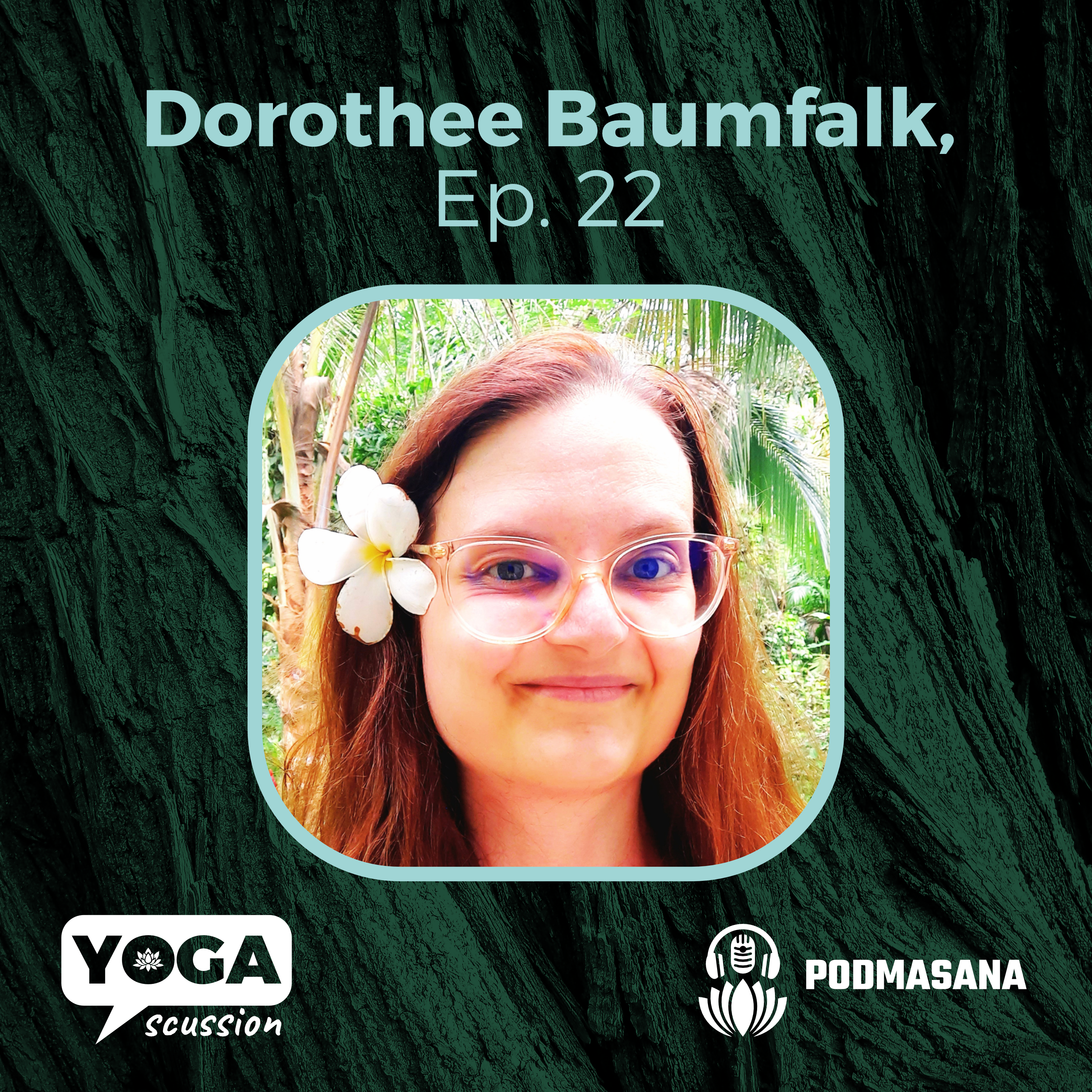
[00:00:45] Brendon Orr: Okay, Gina. Well, today on Yoga Scution, we have Dorothy Bohmfock joining us today, and she goes by Doro as well. She refers to herself as the riding Yogini. And she has a 750 hour certified yoga teacher training or series of trainings under her belt. She's an ayurvedic health coach, also a journal therapist, and she likes to weave therapeutic writing and Ayurvedic wisdom into some accessible yoga practices. And she also specializes in chair yoga for seniors and business yoga. And she's got an interesting journey from corporate marketing to holistic teaching. And so I think there's a lot of different topics that we're going to be able to touch on and dive into with Dorothy today.
[00:01:33] Gina Clingerman: Yeah, this sounds great. You know, I love WR and I love words and I love yoga. So I'm in, I'm in.
[00:01:39] Brendon Orr: Yep, yep, sounds great.
[00:01:40] Dorothee Baumfalk: Hello.
[00:01:41] Brendon Orr: Hi, Dorothy.
[00:01:44] Dorothee Baumfalk: Hi.
Hi, Brendan. Hi, Gina.
Hello.
[00:01:49] Brendon Orr: Yeah, it's great.
It's great to see you. And thanks for joining us for a yoga session, Dorothy. We just gave a little bit of an intro for the listeners for you and such an interesting background and story and what we like to do to just jumpstart each yoga session is just for you to talk a little bit about yourself, maybe how yoga came into your life and what it's meant for you and kind of what's kind of put you on this path and why do you think that you've gone this route with what you're doing with your yoga teaching?
[00:02:21] Dorothee Baumfalk: Yeah, of course. I'd love to. First of all, thank you for having me. I'm so excited.
And well, yeah, my yoga path was actually a little bit rocky because I hated it at first.
My.
Yeah, it took me quite a while to really get into it. It wasn't love at first sight at all.
My parents signed me up for my first yoga class when I was a kid. So there was a course in our neighborhood for school kids.
And it was especially designed for kids who go to school and have problems concentrating and sitting all day and everything. And it was, I think, nine hours or something. And so I went there for nine weeks and I found it so boring. I just didn't like it at all.
It was not my thing. There was barely any movement. It was all meditation and breathing and relaxing and a little bit of stretching. And that was not at all my thing back then and then I never continued doing it. But then yoga really arrived in the mainstream and I was reading about it it everywhere I went and being someone who has a really bad monkey mind, I thought, oh my God, that's what I need. That's actually my thing, I need to do yoga. And I read all about it and it sounded so good and it sounded like just what I needed, but I just could not get into it. I think I just had the wrong teachers because some years later when I had decided, okay, now I really need to stop because I just need to accept I just don't like it. It's just not for me.
I went to Asia and I stayed with a friend and she had a roommate who was a yoga teacher. She was American and there was something about her that was so intriguing. She was so happy, but not over the top happy. She was like happy in a relaxed way. She seemed so in tune with herself and I was like, oh my God, I want that. And yeah, and then she recommended that when I get back to Germany I go to a real studio and not a fitness center. And I did that and somehow it just clicked. And there I was doing yoga every single day. And shortly after my teacher approached me and she was like, hey, we're starting a new teacher training in Gen January and would you like to join? And I was like, no, I've been practicing for myself for barely a year, I cannot teach anyone anything. And she was like, oh, so many beginners sign up just to dive deeper. So I read a little bit more about the teacher training and it was so interesting and I was just excited to learn more about it. And it was a two year teacher training, so not like a three week vacation where you're in a bubble and then you get thrown back to real life. It was with my real life, you know, and I decided to do it. And yeah, I haven't stopped ever since I graduated my teacher training in January 2020 and we all know what happened then.
The pandemic hit. Yeah, and back then I was working in the hospitality sector. I was working at a hotel so I couldn't really work and I needed something to do with my time and I decided to dive a little deeper into ayurveda and journaling. So these were actually my pandemic projects.
So that's quite my path.
[00:06:22] Gina Clingerman: Yeah, I just, I was reading your blog which I just like, I just went in and I read about your experience that you wrote about your teacher training and I'm like, can you tell us about the two year program. I'm so curious, like what that was, like, how it, how it worked in like everyday life, what did it look like and, and kind of what your experience was for two years. That's a long time. A little jealous. I'm a little envious because my first, my very first teacher training was eight months, which I felt like was generous, but two years is generous.
[00:06:54] Dorothee Baumfalk: It is, yeah. And it really is a huge commitment. So I was a little hesitant to do it at first because I always thought of myself that I'm lazy. And this teacher training made me realize I'm not lazy. I can be so studious when I'm really into something. When I'm so intrigued by a topic, I really want to dive into it and I really want to dedicate every waking hour of my day to it.
And so that was an experience of itself.
So it was basically a three and a half hour evening every Wednesday where we had some, some topics that we were covering, like the Bhagavad Gita, how to teach special target groups like pregnant women, kids, seniors, and all the stuff that goes around with teaching. And then we would have a practice and then afterwards a little relaxation. And after the official part, we could also have a little dinner together. There was always something cooked for us at the studio. So right when we walked out, we were able to sit down and have a little healthy dinner.
And then on top of that we would have, I think, four weekends per year where we went to a little ashram in Germany in the middle of the forest. So no cell phone service, no nothing. It was really remote and really calm and peaceful.
And that was like the real immersion, like waking up at six in the morning to go meditate and do pranayama and finish the day off with kirtan in the evening. So it was a really intense experience.
And I've heard people call it brainwashing in the best possible sense because it's really transformative. We were actually encouraged to do yoga every day. So I really tried to do that. And back then, working at the hotel, I had a really crazy schedule. And I started incorporating it into my morning routine because that way when I had a stressful day at the hotel, I already knew, wow, I already had that whole hour to myself this morning. So no matter how this day goes, I still had that. Nobody can take that away from me. And I don't need to hurry, like, oh my God, I haven't done my yoga yet. So. And that's something that stayed with me.
[00:09:36] Gina Clingerman: That's lovely.
[00:09:38] Dorothee Baumfalk: I really loved it. Yeah.
[00:09:40] Brendon Orr: Yeah. And, Dorothy, when you were describing your experience incorporating yoga into your life, and you've touched on this demanding job in the hotel industry, and you later pursued this emphasis of journal therapy and ayurvedic counseling, what I was thinking when you were laying all this out is that if there was a master plan, it wasn't your master plan. Right. It seemed like all this was kind of just being, like, laid out, like, for you. And was there a moment when you realized there weren't just separate interests here, but there was some type of unified path coming together?
[00:10:15] Dorothee Baumfalk: And.
[00:10:15] Brendon Orr: And did that, like, shape how you designed your classes or trainings as you continued to be a yoga teacher?
[00:10:23] Dorothee Baumfalk: Definitely. I knew I wanted to teach, which came later. When I signed up for the teacher training, I was like, oh, I'm doing that for myself. I'm not going to teach anyone. But further into the training, I was like, oh, my God, I love it. I love teaching. I love sharing my passion. And I knew I wanted to teach, and I knew I needed to have something special, and I thought, maybe that's Ayurveda, So I dove deeper into that. But then the journaling thing, it totally came to me, as you said. It popped up on my Instagram feed. I think it was an ad for that course.
And I was like, oh, my God, that's for me. Because I was always such a diary and journal lover.
When I was 13, I would fill page after page after page in my journal with that tiny little lock on it in the 90s, you know, and I was like, oh, my God, journal therapy, That's a thing.
The thing that I have been loving since I was a kid. That's awesome. I need to learn more about that. And then I heard about a yoga teacher who was like, oh, yeah. At the beginning of my sessions, I always have people journaling a little bit. And then that made me curious because writing was my first love. Then came yoga, and then I was like, you can combine those two. That's actually quite a cool idea. But I wanted to do more than just go, okay, now write a little bit and now do some yoga, and then we're done. I wanted to explore more of that combination and why it actually is a great combination and how you can work with those two and not just separately, but also at the same time. So, yeah, that was quite my project.
[00:12:14] Gina Clingerman: Then if Brendan and I were going to take a class with you, could you walk us through what that kind of looks like? Because I've had very profound moments in my Practice where I'm in a pose and it's like this, you know, the words are landing and it's like, oh, I wish I had a piece of paper or I wish I had something I could like, like a dictaphone or something that I could just be like, blah, blah, blah, get this words out. Because I'm also a very word oriented person. But I'm just so curious about what if Brendan and I were in a class with you? What would that look like? How would you teach to us? Incorporating the yoga and the journaling.
[00:12:51] Dorothee Baumfalk: When I incorporate journaling into my class, I always use some meditative flows and some static poses that are very yin. Like so you would flow through a little sequence and then you would maybe rest in child's pose for a few seconds. And then I would give you your first journal prompt, the first question, and then you're going to reflect on that question for a few seconds while staying in child's pose. And then you're continuing with your flow for a few moments. And then afterwards you get a few minutes to write. I'm going to give you that prompt again after it had a little while to marinate kind of, and then you can write about it. And you always get about three to four minutes. So it's not a lot, but it's enough to get the gist of it.
And then afterwards you're coming back into the resting pose and then we're continuing with the rest of the yoga session. So I make sure that it's not okay, now we're in tree pose. And now you're going down to the floor to right. And now you're going back up and doing a standing flow. So I try to make sure that it's really organic, the movements and the writing and also the kind of prompt that I'm giving after which pose. So for example, if I have just taught a warrior pose, I'm gonna give you a journal prompt that's working with optimism, courage. I would ask something like, what is something you're proud of and why?
Or what is an obstacle you've overcome and what have you learned from it?
And if I have just taught a forward fold before, I would ask a question like, is there something in my life I want to let go of and how can I do that? So I make sure that the questions and the asana energy kind of go hand in hand.
[00:14:59] Brendon Orr: Yeah, that's cool. That's cool.
[00:15:00] Gina Clingerman: Yeah, it sounds really nice.
[00:15:02] Brendon Orr: And applying this approach. Dorothy, has there been maybe a specific moment that you've had with a student or a client where you saw this combination of yoga, journaling and Ariveda maybe coming together in a moment of breakthrough or deeper insight for someone that you might be able to share with us.
[00:15:24] Dorothee Baumfalk: Yes, I had one experience that I love to share when I'm teaching journaling sessions, and it was a session where I taught a journaling method that's called Brain Dump. And that's actually a pretty cool method where you set a timer to 10 to 15 minutes and you write without letting your pen leave the paper.
And there might be a time where you think, oh, my God, I don't know what to write anymore. And then you just keep writing and you write exactly that. I don't know what to write anymore. I don't know why this stupid yoga teacher is making me write stupid things here when I don't even know what to write. Because what happens there is we have so much on our mind.
There is a lot going on in our lives.
We have so much to do, so much to think of. And these things that are at. At the forefront of our mind, they're going to flow onto paper right away.
And then there's that little moment where you don't know what to write anymore, but. But you keep going.
And that's when your subconscious comes into play and you're going to write about things where you're like, oh, my God, I didn't even know that was a thing still for me. And that's what happened to one of my students.
She came to me after class and she was like, I just looked at my notes and I wrote about a friendship that ended some time ago.
And I didn't even know that it was still brewing inside of me. I didn't even know I still had anger or resentment towards that person.
And now I know I do, and I feel like there's still so much to let go of. And now I know I need to work on that still, because I thought it was done and it's obviously not. So that's so interesting. And I was like, oh, my God. Yeah, that's what this method is for. I love that it worked for you. And she was so surprised.
And that's what I love about journaling. It can really dive really, really deep.
[00:17:31] Brendon Orr: Yeah, for sure.
[00:17:34] Gina Clingerman: When you first started this journal training course that you took, I mean, when I first started teacher trainings, it was.
I felt like, oh, yeah, I'm just here to learn about yoga. But then, like, other things would come up, like, deeper personal things would come up, and it was like oh, this is actually a journey of self exploration of, like, getting to know myself. So can you maybe speak to some of those kind of moments like that in your journal speak training that or not journal speak, but in your journaling training that you were doing, where you were like, oh, I'm here to do this because I love this. But then, like, profound things kind of came up for you as a person in the training.
[00:18:13] Dorothee Baumfalk: Yeah.
So for me, when I was journaling as a kid, it was more like documenting my everyday life. So today I did this and then I saw that person, and then I did this, and then I had that for lunch, so it wasn't really deep.
And then journaling, I learned, is far more than just keeping a diary. It's about getting to know yourself more, just like yoga.
And it's about having something to fall back on when you write over a longer period of time. You can take a look into your journal and maybe you will see a pattern.
And that's what I did. I have been struggling with anxiety, and that was something that really improved when I journaled.
It was so great to have the journal to tell everything to, you know, because you just know the journal won't tell anyone, not even by accident.
It won't judge you.
It will not get bored of your rants. It will not roll its eyes at you.
And that was something that really helped me. And writing the journal is already great. But my moments where I was like, oh, my God, I'm really onto something here. Where when I had already written quite a few pages over a while and I was taking the journal to take a look at it and reading about it and about a special time, you know, I was like, oh, my God, that was a really hard time in my life. I need to look at what was going on there because now I'm feeling like I did back then.
So I had the chance to grab my journal, flip to that page, because always use dates when you're keeping a journal. That's the lesson here.
And I was able to look back at that time and reflect, what was it that I was doing back then that I'm doing right now that's hurting me?
And what is it that I'm knowing right now that I didn't know back then, but I wish I knew back then?
And that was so insightful for me. That was really, really something I was so grateful for.
[00:20:37] Brendon Orr: Yeah. And, you know, I'm a latent journaler, I guess you would call it. And it's a process that is really all about awareness. In terms of whether or not it's gonna actually, I think, do something for you. Right. And then I've really appreciated that synergy with yoga. Right. And can you maybe speak a little bit to that tangent, Dorothy, about the role of awareness not only in a yoga practice, but also just the act of journaling in a way? Like, are you becoming aware of your thoughts? Are you even aware of how you're feeling as you're. As words are coming through you to the page or the screen?
[00:21:21] Dorothee Baumfalk: Yeah, I love that question because it really shows how much yoga and journaling go hand in hand.
They have really, really similar goals. Both want to clear the mind. Both want to bring you closer to your truer self.
Both want to clear the path for you to just be happy and let go of everything that weighs you down. So it's a really, really great combination. And I always say one thing benefits the other. There are so many people who are like, yeah, yoga, yes, sounds great, but I'm just not able to sit down and relax and do some gentle mindful movement. I just want to go out for a run or a swim. And so having them write a little bit beforehand really gets them into the mood of being on the mat and nowhere else in their head, you know, because sometimes when we're on the mat, we're already in the supermarket doing our grocery shopping.
And when you write beforehand, you leave all the stuff at the door. There's no okay, now you had a full day and so much stuff is going through your head. But now that you're here in the studio, you have to forget all about it, because now you're on your mat. Now you're on your meditation cushion, and now you are totally mindful and peaceful and calm, and that's just not how it works. I know that. And writing can help. Writing can be the channel for all these thoughts. You can just get them out, do your yoga and feel great.
And also the other way around, some people are like, yeah, I just don't feel calm enough to, like, light a candle, put on some music and sit there, take my journal out and write a few pages. I'm just too antsy. I just can't sit still. And then a few dynamic sun salutations, a nice yoga flow, and then you're calm enough to write, and then you're really there. So it's really amazing how yoga and journaling can benefit each other and help you to actually be there and be present and be mindful.
And if you can't do one, maybe you can do it with the other.
[00:23:54] Brendon Orr: Absolutely. And, you know, even just hearing you lay all that out, it seems like journaling can be this excellent bridge between a physical practice, whether this is yoga or exercise, and then allowing someone to become familiar with something a little bit more still something quite present. Right. And I think, is it a goal of yours or do you. Have you seen this help people who have gone through this approach become more comfortable with a practice like meditation, a sitting meditation? Because essentially, in my mind, anyway, listening to you, you're going from active to something in between where there's an activity here, right? The activity of journaling, but it's kind of introducing you to this stiller space. And then if you can get to the point where you can actually sit on a cushion, even if it's just for initially 30 seconds or just even five seconds, and then build from there, build the stillness from there, I think that's potentially where journaling, even though I didn't think of it that way earlier on in my life, can be perhaps a tremendous tool to kind of be that bridge between activity to physical stillness. What do you think, Dorothy?
[00:25:12] Dorothee Baumfalk: That's exactly what it is. It's like, we have all heard of Patanjali and the stage of the yoga path, which he calls the withdrawal of the senses. And that's exactly what journaling can do.
If you really do it for you and not like, okay, now I'm gonna write something that sounds really nice.
Then you really sit down and you sit with yourself and with your thoughts and with your worries and everything that's going on in your head and your heart, and you just pour it out onto paper and nothing else around you matters at that time. And that's withdrawing the senses at its best. And oftentimes the physical stillness is so hard for us because there's so much going on in our mind.
That's another thing I really find fascinating about yoga, like how you feel super stiff when you're feeling very excited or something, you know, then you can't really relax. You can't really let go. You cannot lean into that, that softness that might already be there. And I've experienced that firsthand.
So first dealing with the stuff in your head and then getting into the physical stillness, that's something that was really eye opening for me, but also the other way around, just getting it all out on the mat, just breaking a little sweat, and then sitting down when I'm already exhausted and not like antsy and shaking and, oh, my God, I need to move. There's something inside I don't know what it is, but I'm so nervous, and I need to do something, and I cannot sit still and I cannot grab one single thought and keep it for a second.
That's also a really great thing to do.
[00:27:15] Brendon Orr: Yeah. And just even hearing this a little bit, it's reminding me of, you know, we sometimes as people who've been practicing for a while or teaching for a while, we can maybe be a little bit.
I don't want to say negative, but we kind of like poo, poo, asana a little bit. But asana really is there to act as, like, a teacher for the mind in a way. It's like, hey, use me as the laboratory and start going within. So I just loved where this conversation was going.
[00:27:45] Gina Clingerman: Yeah. I just was thinking about your Ayurveda training and how when you were talking about sometimes we need to, like, write it all out and then settle in, or sometimes we need to move it up. You know, we need to shake things up so we can settle in to write out. And I was. It struck me as being like, oh, yeah, this kind of reminds me of the doshas, right? Like pitta, vata, kapha. Like, if you're real pitta, you know, maybe that, you know, getting on the mat and, like, breaking a sweat and getting in there before you kind of settle in with your thoughts. And if you're maybe more kapha, you know, you might not. That might not appeal to you. So do you also blend Ayurveda? Do you, like, have a class or maybe workshops that you do where you're like, okay, for the pitta folks, we're gonna try this. For the vata folks, we're gonna do this. For the kapha folks, we're gonna do this.
[00:28:38] Dorothee Baumfalk: Yeah. Of course, it's really hard to cater to every dosha, to every Ayurvedic type in your courses. But what I did was a course where every says every session was under the motto of a different dosha and a different element, because the doshas are based on the elements.
And the thing that Ayurveda and journaling have in common is that they're all about getting to know yourself better.
When you write and you take a look back at what you've written, then you can maybe see a pattern. When you get to know your Ayurvedic type and what that actually means and how it influences you and how it might influence your reactions to certain things, you might get so much more gentle with yourself because you just understand yourself better, you know? Okay, maybe I'm not lazy. Maybe I just have too much kapha right now.
Or maybe I'm not a flaky person. Maybe I just have too much vata right now. And it also is a very empowering thing because you know that once you know what your imbalance is, you also know you can do something about it.
And with Ayurveda, it's super simple because opposites balance each other. And so if you know, okay, well, I have way too much vata, and vata is a cold dosha. Maybe I need a little bit more warmth. Maybe I need. Maybe I need a little bit more to drink. Maybe I need some time by the water because it's also dry dosha. So you can really see what's going on inside me right now, what's influencing me right now. So it really goes very well together. And I love to use journaling to develop a little bit more of a feeling for the doshas and the elements and their influence in everyday life, because they are everywhere. It's not some fancy woo woo concept that's not affecting anyone but spiritual people. It's affecting everyone. The elements and the doshas, they are everywhere in our food and the weather, even in our interactions with other people.
For example, if I have a really calm conversation with a friend and I feel heard and nurtured, that's kapha energy. If I have a heated discussion and we're talking business plans and exchanging ideas, that's pita energy.
If we are switching from topic to topic and we're losing track of what we even started with, that's vata energy. So it's really everywhere. And I love to use journaling to.
Yeah.
Show that to people.
[00:31:47] Gina Clingerman: Yeah, yeah.
[00:31:49] Brendon Orr: And pulling on that thought thread earlier, Dorothy, of just kind of really getting in touch with who you are, what you are, you know, that inner exploration.
I think a lot of yoga teachers, maybe most or all, have gone through this process of trying to find their own authenticity voice. Right. And I know that process, I think for me, took maybe around a couple years post training. I don't exactly have a perfect mark on the calendar for it, but I want to say it's around two years. And so you were talking about using journaling and Ayurveda to find that own authentic voice. I'm curious, Dorothy, what does authentic voice mean to you in the context of teaching yoga? And you've touched on, like, prompts earlier.
Like, is there a prompt that you might use if you were coaching or teaching other teachers who maybe feel stuck or unsure about their authentic teaching Voice, what would you. Where. How would you kind of steer them or help them get to that discovery point?
[00:32:50] Dorothee Baumfalk: I love that you're asking this, because I am actually teaching other teachers to find their authentic voice using journaling and Ayurveda. And one question I give them in a workbook is, what would you picture your perfect life as a yoga teacher to be? Would you be teaching retreats? Would you be teaching online? Would you be teaching in studio classes every week? Would you be teaching pregnant women? Would you be teaching kids? Would you be teaching really athletic stangart classes?
And then I encourage them to really question, why is that your ideal picture? Is that really what reflects what you are and what you love doing and what you're good at? Or is that just some picture that maybe was planted in your head by some people you follow on Instagram?
You know? So first I make them see, okay, that's my wish. That's where I want to be as a teacher. And then I make them question, is that really something that. That fits me? Is that really me? Or is it just something where I think, oh, yeah, that sounds good, and I like the idea of it, but do you actually like it and not just the idea of it? So that's what I'm asking them.
[00:34:15] Brendon Orr: Yeah. It's an interesting topic because I've been asked the question, well, if you've been teaching for so long, why aren't you doing, like, retreats on a regular basis? And. And the only honest answer I can give is that I don't know if it's gonna connect me the way I would wish to be connected to people and. Or perhaps the people who I might be best connected to. You know, not to say that you can't have these great connection points happening at a retreat, but a lot of the time, sometimes you connect and then you go your separate ways, and you might not ever actually have any type of connection. Whereas, contrasted with a regular weekly class where you have the opportunity to really kind of get to know and connect with people and see growth, share growth, continue to learn, even as a yoga teacher, I found those experiences personally to be more authentic. I'm curious, Dorothy, like, what has kind of materialized for you in terms of what has really connected to you closely?
[00:35:18] Dorothee Baumfalk: Yeah, for me, also, the retreat stuff is a kind of topic that's been on my mind for quite a while, and it still is, but not in the same way as it used to.
So I used to dream of, like, hosting retreats all over the world back to back.
And one day I realized that is not what would make me happy. Because I'm introverted. I need my alone time to rest and to recharge my batteries. And just the thought of holding space for a group of people over a longer period of time and always being there if they have questions, that just stresses me out.
And I know that I need more alone time. So right now I'm looking into maybe teaching weekend retreats. Maybe that's a thing to just dip my toe in the water and see if it's really not at all for me or if I can still do that. But yeah, it's also, yeah, that's a step of getting to know yourself and distinguishing between what I really want and what's just something that seems attractive to me on the outside.
And what I do to get my teachers there is first, I do an Ayurvedic consultation with them. And we dive really deep into what their constitution actually means. And I have them deal with it for a little while with workbooks and everything and meditations so that they really can get to know their own constitution and what it means for them. And then I question, do you see yourself in there? Is there something in that description where you're like, oh, my God, yeah, now I finally know why I'm like that. Or is there something where you're like, oh, no, I cannot relate to that at all, even though Ayurveda says it's typical for me.
And then I go a little deeper with them and I see, okay, which type of teaching would maybe be good for you? And what is it that you like teaching or what is it that you like practicing? Because when you hate to practice Yin yoga, you will not be a good yin yoga teacher, even if that might fit your Ayurvedic constitution. So it doesn't make any sense. Then
[00:37:53] Gina Clingerman: it strikes me that the work that you're doing and the work that you've done for yourself personally and that you're doing with other teachers and your students is.
It's very deep.
It's something that we don't get to encounter in our modern society. Like, a lot of what we do in modern society is like, here's your cookie cutter life. Like, go through school, go to college, get married, have kids.
Like, it's not very deep. And it strikes me that your process, your yoga style, your teaching is really asking people to meet themselves in a deep way, like at the bone, at the core, to figure out who they are not. I love that you referenced Instagram because it's so easy to get sucked into this world that's like, oh, this is what I should see as a yoga teacher. Like, like, personally myself, I don't have like a yoga shaped body, you know, quote unquote yoga shaped body. We all have yoga shaped bodies, but I don't have that Instagramable yoga shaped body. And then you see those kinds of things and you go, oh, well, I guess I'm not as good. But you're doing the opposite. You're being, you're asking people to meet themselves in the interior world and be like, this is enough. Who you are now in this moment is enough. And I think that that's such a grand mission because we all wanna be accepted and we want to be seen and we want even in a way, to be celebrated for who we are. And I don't think that our society's there yet in the ways I think we were getting there. But we're having a little bit of a jag right now across the world. And that is really meaningful work to, to invite people into that space, to hold them in that space, to nurture them in that space.
And in that vein, I'm wondering, did you have teachers who did that for you, or was this work that you just kind of intuitively went towards yourself and you were holding that space for yourself? Like, how did you come out of your cocoon?
Go into the cocoon knowing, I'm sort of doing this deep work. And then you kind of came out like, what was that? Like?
[00:40:12] Dorothee Baumfalk: It was a lot of personal work and also feedback from my students because I was also really influenced by Instagram. I also do not have the quote unquote yoga body. I do not have the quote unquote yoga apartment with the fancy backdrops to practice yoga and film some reels, you know, And I was never really athletic, and the athletic side of yoga was never the side that appealed to me the most. I came to yoga because of my monkey mind. And I sometimes felt that I'm not enough. When I saw all these people doing all these amazing things on Instagram, like handstands and scorpion and everything, and I was like, oh my God, I'm not good enough. I need to be able to do all these things in order to be a great teacher.
And that was so limiting.
And I felt really small. And then I had to start teaching because we were really doing it early on during teacher training. And then I had students come up to me after class and giving me such positive feedback, even though I wasn't doing anything of that fancy stuff that I felt that I needed to be doing, and I wasn't.
I decided to be authentic and not teach any of that because I cannot really demonstrate it. I cannot really cue it because I'm not able to do a handstand. So I cannot really cue it. I cannot really tell you where to focus your thoughts in that moment because I've never done a handstand before.
And so I decided, okay, well, I'm not Sporty Spice. I'm just gonna roll with it. I'm the chilled, meditative Yogini, and that's what I'm gonna do. And then I had such great feedback, and I thought, okay, well, maybe I hit a nerve there. Maybe I struck a chord in some people, and that's actually what a good teacher does. So maybe even without being able to do a handstand, even without being able to do the Scorpion, maybe I can still be a good teacher with just being my small, little, regular, ordinary self.
And that was a groundbreaking thought for me. And I really started to question, what is it that makes me special? What is it that distinguishes me from these slender, pretty girls in fancy leggings, drinking matcha in front of macrame backdrops, doing handstands every day? You know, what is it that makes me a great teacher? And what is it? What's my usp, so to speak?
So, yeah, it really had a lot to do with my students feedback.
[00:43:06] Brendon Orr: Well, I guess when Spice Girls are rebooted at some point, inevitably in the future, maybe you can audition for the Chill Yogi Spice Girl, and they'll have, like, a seat. They'll have a seat for you. Like, where was Yogi Spice Girl? Who was that Spice Girl? Yeah, that would have been my favorite. But, yeah, Dorothy, I wanted to touch on because it seems like it's one of your passions, along with journaling, and it's not necessarily unique to you, but it seems something that is becoming more emphasized each year that I remain in the yoga teaching space, especially in the west, that the emphasis on accessibility and inclusion and, like, I'll just be open and honest here. I remember when I was probably three or so years into yoga teaching, when I became aware of chair yoga. And honestly, this thought that I had was more reflective of truly where I was in my yoga journey, because essentially, I scoffed at it. I'm like, oh, like, what is this? You know? And then. But the truth of the matter is, is that I've been able to see and witness how a lot of the times at studios that I've taught at or met teachers who have Taught this style of class.
It's really a great way to, again, back to thinking of journaling as this bridge to meditation. The chair is like this bridge to, I think, giving people a bit of like this comfort and support system to trying things that they probably would never be able to get themselves to try otherwise. And how that can lead to a lot of positive things.
So I'm curious, like, where did this passion come from for accessibility and inclusion and how do you adapt, like the integration of journaling and ayurvedic wisdom with any of this teaching with chair yoga?
[00:45:01] Dorothee Baumfalk: I think it had a lot to do with my grandfather who developed dementia while I was in teacher training. And whenever I could, I would go home on the weekends and visit him and my mom was taking care of him and he would always remember who I was, but he wouldn't remember my name at any occasion. So he was like, yeah, that's my granddaughter. And then he would get so upset that he couldn't remember my name. And eventually we had to put him into a home because my parents home is full of stairs and he wasn't really mobile anymore, so it wasn't possible to take care of him at home like she wanted to.
So we went to visit him at the home and there were so many awesome elderly people. And I just realized, oh my God, I love them so much, so much. They're so close to my heart and I love talking to them. And I also love kids. I love my friends kids to death. I don't have any of my own, but I found myself getting really annoyed when the kids continue to ask questions after questions after questions. And on the other hand, with my grandpa, when he had dementia and had to ask the same thing over and over again, I was patient. I could deal with that, that.
So I thought maybe working with elderly people is something that's for me. So I wrote to a few homes back in Frankfurt where I was living at the time, and I had a really great response. And I started teaching at a home in the summer of 2020 when it was possible to teach outside. Because of Corona, it was not possible to do it inside.
And they had a little garden there and I was teaching there.
So we put chairs out there and then we would have a little yoga sessions there. And in my first class it was only one person. And then after a few weeks I was teaching four classes per week and there was a waiting list.
So yeah, they loved it so much.
And because it was outside, there were always people walking around and they got curious, what are they doing? And there was that one lady who was watching a session, and she came to me afterwards and she was like, yeah, I told my granddaughter that there's a yoga offering here. And she told me to go, but, you know, I'm having such trouble with my shoulder. And the doctors told me they cannot do anything for me because I'm almost 90. And they were like, no, we don't want to put you through surgery, so here's some painkillers. Deal with it.
And yeah, so she was insecure about trying yoga because she wasn't able to lift her arm like that. She was only able to do it like that, you know, so she thought she couldn't participate because she couldn't lift her arm.
And I was like, come. Anyways, it's not acrobatics. We're not doing Cirque du Soleil here. We're doing something that's supposed to be good for us and not something we're supposed to. Supposed to be good at. So everyone is met at their level.
And yeah, we just want to do something good for us. And yeah, she came to my class twice a week, and at one point she told me, you know, I haven't had any painkillers in three weeks. And I think that's because of the classes. And I feel so happy and I feel so much softer. And that was one of the greatest feedbacks, if not the greatest feedback I've ever gotten as a yoga teacher. And I think that that's why accessibility and making known that yoga is for everybody, even if you don't look like these yoga fairies on Instagram.
So, yeah, that's yoga fairies.
[00:48:56] Gina Clingerman: I love it.
[00:48:57] Brendon Orr: Yeah. Yeah. I think there's some bumper sticker potential with that one. We might have to word for it a little bit, but.
[00:49:02] Dorothee Baumfalk: Yeah, yeah, I love that.
[00:49:08] Gina Clingerman: I just love what you said there. We are doing something good for us, not something we're good at. And I love that because, God, we're so into productivity and, like, being, like, performative and this is not what yoga's about. Like, and I love. Oh, my gosh, my heart is bursting with joy that you're working with elderly folks and people who, like, have limited mobility. Because just that alone, going from one student to four classes a week with a waiting list shows how much that population and the world in general just needs accessible yoga. I just want to totally heartfelt plug for everything you said and, like, accessible yoga. We just need those classes. We need.
We need that. We need to do things that are good for us.
[00:49:54] Dorothee Baumfalk: We really do. And it's so much more than just movement. It's also community.
I just loved it. Like, my heart burst when I saw friendships developing in my classes.
People that didn't know each other before were suddenly coming and leaving together, chatting and making plans to have a coffee later. And it was just so heartwarming.
[00:50:15] Gina Clingerman: Community and connection. And those are the things that we're like, sorry to get all weird, but, like, capitalistic, you know, capitalism, it just, like, tries to break those things down. Community and connection, and it tries to replace them with buying things and paying for services and goods. And it's like, that's what we need. We need community and connection. And I love that you are creating that, like, in such a beautiful way.
[00:50:44] Dorothee Baumfalk: Thank you.
[00:50:45] Gina Clingerman: Should be so proud of yourself.
[00:50:49] Dorothee Baumfalk: Well, thank you, Dorothy.
[00:50:52] Brendon Orr: I'm wondering, where can people find more information about you or how can they connect with you and what you're offering?
[00:51:02] Dorothee Baumfalk: Well, it's about my.
My blog, my website. It's the writingyogini.com the/writing/yogini.com and it's in English as well as in German.
I really wanted to reach an international audience because I spend a lot of time abroad, and I have many friends there, and I also wanted them to take part in that. But then I also taught the elderly people, and they usually don't speak English, so. So I wanted to cater to everyone. So it's bilingual. And also my Instagram, the Full Stop writing. Full Stop Yogini. And that's where I share my thoughts and my offerings, and I post all my sessions there, my workshops, my courses. The yoga teacher coaching that I was talking to you about is still in the beta phase. I'm working with. With three awesome teachers right now who are my. Yeah, trial objects. You can say, yeah, I'm working with them, learning as I go. They're giving me great feedback. One is already done, and the others are still on their journey through the program, and I'm loving to see what it does for them so far. So I'm definitely gonna keep doing that. And once it's out in the open, I will definitely post it on my Instagram and on my website as well.
[00:52:29] Brendon Orr: Cool. Yeah, we're looking forward to that, Dorothy.
[00:52:32] Gina Clingerman: And then the last question is, what three words would you use to describe what yoga means to you?
[00:52:43] Dorothee Baumfalk: It's definitely connection, what we just talked about. Connection to others, but also connection to yourself.
It's mindfulness. Being mindful with your body, with your mental health, with your resources.
And the final thing for me I think might be joy. For me, it's joy going on my mat, having that privilege to move my body, having that privilege to breathe and work with my breathing and yeah, so it's always a great joy for me and it always lightens my mood.
[00:53:22] Gina Clingerman: Beautiful.
[00:53:22] Brendon Orr: Those sound like three very thoughtful and mindful words to describe yoga that Journaler would be able to come up with. And so thank you, Dorothy.
[00:53:35] Dorothee Baumfalk: Thank you.
[00:53:37] Brendon Orr: Hey listener.
Yeah you.
I'm talking to you actually.
If you've been enjoying the show, please consider leaving us a review on your podcast listening platform or giving us a shout out@yoga scussionodmasana.com or you can also reach out on the socials. We are on Bluesky, mastodon, Instagram and YouTube.
Sharing a review with others helps a lot.
Thanks for listening and leaving a review.
[00:54:19] Dorothee Baumfalk: Sa.