Episode Transcript
Brendon Orr (00:00)
Gina, we've got some interesting and special guests with us today on this episode of Yoga Scussion just to contextualize it for us and listeners. So my wife and I have been fortunate to be able to practice with a community of people, ⁓ almost every Sunday when people can show up to a temple and
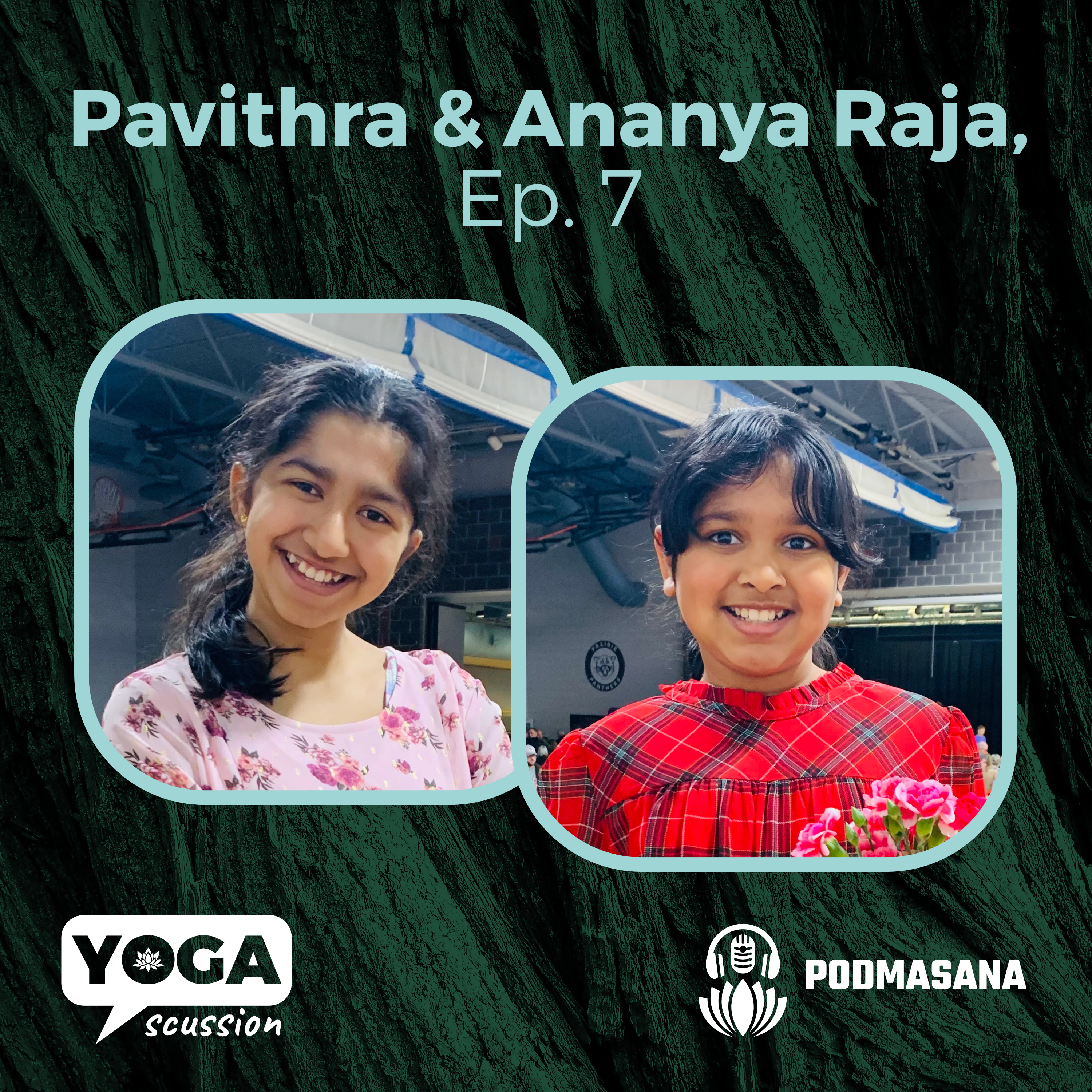
Pavitra and Ananya are young girls that tend to roll out their mats next to next to me and my wife. And they're very interested in learning yoga and they are very, very smart and talented in all sorts of ways. And so we're welcoming them on to this episode of Yoga Scussion and we're going to kind of.
learn a little bit about their experiences and journeys and we're also going to talk about the eight limbs of yoga later.
Gina Clingerman (00:53)
I'm so excited for this conversation with them.
Brendon Orr (00:57)
Alright, well let's let them join us.
Hi Pavitra. Namaskar.
Ananya Raja (01:01)
Hi!
Pavithra Raja (01:02)
Namaskaram.
Brendon Orr (01:04)
Hi Ananya, namaskaram, nice to see you. Gina, absolutely, absolutely. Gina meet Pavitra and Ananya, Ananya Pavitra meet Gina.
Ananya Raja (01:05)
Namaskar.
Pavithra Raja (01:07)
Thank you so much for having us here.
Gina Clingerman (01:14)
Hi Pavitra, hi Ananya, I'm so excited to talk to you guys today.
Pavithra Raja (01:15)
Hello.
Ananya Raja (01:20)
Yeah, so excited to meet you too.
Pavithra Raja (01:20)
Same here.
Brendon Orr (01:22)
Yeah, so we ⁓ really appreciate you joining us and we were thinking that maybe you both could talk or take turns talking about your experiences with yoga so far and then we might have some questions for you and then we'll jump to our discussion of the eight limbs of yoga later. How does that sound?
Pavithra Raja (01:42)
Sounds good.
Brendon Orr (01:43)
All right, which one of you wants to go first? Is it gonna go by age or alphabetical based on name?
Gina Clingerman (01:49)
He
Pavithra Raja (01:51)
I mean, I'll start first. I'm Pavithra Raja, 15 years old and a freshman in high school. technically both of us started our yoga journey around the same age. Whoa, same age is not the right way to say it. Like same time. So like it starts with when my mom and dad go to yoga class one day and decided to like show us some asanas that they've done. And we were like, can we try them?
Brendon Orr (02:04)
Mm-hmm.
Pavithra Raja (02:18)
and they showed us and we were able to do it and that like sort of brought us to yoga class and made us interested in yoga.
Brendon Orr (02:27)
Yeah, that's so cool. That's so cool. How about you, Ananya? What's your take?
Ananya Raja (02:33)
Yeah, I'm Ananya Raja and I'm 12 years old and I'm in seventh grade. And just like Pavithra said, our parents showed us a few of the asanas and we like actually like surprisingly we could do some of them and it was kind of hard at first, but our parents talked to the Guruji and he said that we could join and we were really excited for it.
Brendon Orr (02:54)
What would you say clicked for each of you with yoga? Like what do you think ⁓ has kept you practicing?
Pavithra Raja (03:05)
The thing that has kept me practicing is that the asanas get harder and harder and I want to like be able to do it better and better and like seeing all the uncles and aunties like doing the yoga poses just makes me want to be able to do it like them. Also Guruji is able to do it so flexibly and easily that's just like another thing that makes me want to do it better.
Brendon Orr (03:27)
Yeah. And he's, in his eighties. So Ananya, I believe, you know, you had talked about, know, ⁓ how inspirational that may be. Can you maybe speak a little bit to what it's like to see someone, ⁓ in their eighties who can do not just the, not just poses, but maybe is demonstrating like a kind of temperament, right. That might come with a regular yoga practice. Could you maybe speak to that a little bit?
Ananya Raja (03:53)
Yeah, for sure. So Guruji has always been like a great source of support while doing yoga.
So even though we didn't do it like correctly or like we did few of the poses like wrong, he like teaches it very calmly. And like you said, Brendon at the age of 85, he's like really good at his yoga. I noticed that he does it like on the hard floor and like, I can't even do that. Like we use a yoga mat, which is like really inspiring. And I see all him, I see him doing the yoga and it inspires me.
Gina Clingerman (04:18)
You
Well, in the write up that you guys sent us, you said that Guruji was very playful and I just thought that was so lovely that he provides that atmosphere. Do you guys think that his playfulness helps you learn more? it's almost like an invitation into the fun parts of yoga.
Pavithra Raja (04:48)
Yes,
it also makes us feel like yoga is not a thing we have to do, a that we enjoy doing.
Gina Clingerman (04:56)
Yeah.
Ananya Raja (04:56)
We also
like in between we have to like leave for like Bala Vihar which we do at the temple too and for like not only do we do yoga he also teaches us like some songs and that's also really fun. We learning like new stuff too.
Gina Clingerman (05:11)
Can you tell us more about Bala- Bala- Sorry, Balalihar? Balavihar?
Pavithra Raja (05:15)
Balavihar? ⁓ Yes.
Basically it's a class where we are learning slokas relating to gods and goddesses and learning a lot more about our Hindu culture and we both do Balavihar at the Hindu Cultural Temple and it just has taught us a lot and I've been doing it since I was like seven years old.
Brendon Orr (05:39)
Mm.
Ananya Raja (05:40)
And I've been doing it since I was like five, so.
Brendon Orr (05:43)
Yeah, it's so, yeah. Yeah. And one thing I particularly enjoyed, you know, there's some ⁓ classes ⁓ where you two are singing with a Guruji or otherwise. ⁓ What is that type of singing called? Does it have a name?
Gina Clingerman (05:43)
awesome.
Ananya Raja (05:44)
We
really love it.
Pavithra Raja (06:02)
Well, sometimes they're called slokas. It's kind of like chanting mantras to like God. But like there's not exactly a full-fledged name towards them as far as I know.
Brendon Orr (06:04)
Mm-hmm.
Ananya Raja (06:12)
So like there's short slokas,
like the short ones are called slokas, but like the longer ones that we do, that Guruji sings is like bhajans, like different, like bigger songs, yeah. They have like different names to like different gods that they.
Brendon Orr (06:22)
Mm-hmm.
⁓ Would the two of you be interested in honoring us with a quick example of one of these?
Pavithra Raja (06:36)
Sure, we haven't really practiced on like a similar sloka. Do want us to do a short one?
Brendon Orr (06:43)
Yeah, I think a short one would be good.
Pavithra Raja (06:46)
Do you want to start on in here? ⁓
Ananya Raja (06:57)
This is like talking about God Rama.
Brendon Orr (06:59)
Mmm.
Mmm. Thanks, Ananya. That's great.
Ananya Raja (07:04)
Yeah.
Brendon Orr (07:19)
Mmm, lovely. Now what would you translate that to Pavitra?
Gina Clingerman (07:20)
my gosh, beautiful you guys, thank you.
Pavithra Raja (07:23)
Thank you.
Basically, it's talking about Krishna and like His life and how it's like being done and like why we're celebrating Krishna.
Brendon Orr (07:36)
Mmm. Thank you both for doing that. Really appreciate it. we were see how we were talking about what we could talk about ⁓ on this yoga scussion and it seems like we kind of want to take a trip around the eight limbs of yoga. Does that sound good? Okay. Well, Gina and I talked and we thought that I might start with the Yamas. So here we go. Okay. So I'll ask these questions and then maybe ⁓ you both can speak to these.
Ananya Raja (07:40)
Yeah. Yeah.
Pavithra Raja (07:40)
Thank you so much.
Yes.
Brendon Orr (08:06)
as we move through the limbs. Okay. All right. So for the Yamas, I'll start with you Pavitra. You know, they're sometimes referred to as the five moral restraints. And we have Ahimsa, which is nonviolence. How does that resonate with either of you, Pavitra or Ananya, ⁓ this concept of nonviolence?
Pavithra Raja (08:09)
Okay.
Yes.
Basically as a himsa, we have it our balavihar class as a name for our classes. Basically it's like teaching us not to hurt others or ourselves. And it resonates in schools or in any other places. I try my best not to hurt anyone physically or mentally and treat everyone with the respect they deserve.
Ananya Raja (08:53)
Like be kind to everyone typically.
Brendon Orr (08:53)
Hmm.
Yeah, yeah.
Gina Clingerman (08:57)
I love that you say to ourselves too. I feel like that's also implied and sometimes we forget that.
Ananya Raja (08:58)
Save.
Brendon Orr (09:05)
Yeah, yeah. No, and it's good that you two are learning about all that and practicing it at a young age for sure. And so the next yama is Satya, this concept of truthfulness. How do each of you think of this concept?
Ananya Raja (09:08)
30.
How I would say is like we don't lie typically like we be truthful to everybody my family friends even my sister.
Brendon Orr (09:32)
Hahahaha. Pravita, does she always tell the truth? I wanna...
Pavithra Raja (09:39)
I mean, usually she says the truth to me. But to my parents, I will keep it as is, as she said.
Brendon Orr (09:42)
⁓ I believe you, I believe.
Gina Clingerman (09:48)
Yeah.
Brendon Orr (09:51)
Yeah Pavitra, what do you think of this concept of truthfulness?
Pavithra Raja (09:55)
Well, it's really important because like in the past I had this tendency to like hide some stuff and then like realizing that being truthful kind of just like opens up the idea that not everything has to be done by yourself and that everyone understands you easily and it also builds up trust and you're able to trust someone and they're able to trust you which just makes it much more easier and like lowers the weight you feel in your chest.
Ananya Raja (10:07)
Yeah.
Brendon Orr (10:25)
Yeah, wow.
Gina Clingerman (10:25)
Wow, that's, I feel like I just got a wisdom upload. Like, thank you.
Brendon Orr (10:31)
Yeah, like I'm taking that wisdom nugget home
with me. ⁓ Yeah, awesome. So and then the next Yama is Asteya, this concept of non-stealing. How does that land with both of you?
Gina Clingerman (10:35)
Yeah. Yeah, what an answer.
Ananya Raja (10:49)
To really like you're yourself and you could do anything.
Pavithra Raja (10:52)
Okay so, non-stealing is just basically like trying not to feel like the urge of needing something that's not yours and basically with the non-stealing aspect of Yamas, it just like allows you to realize that you have what you need and you don't need to take anything away from others.
Brendon Orr (11:11)
Mm. Great.
Hmm.
Gina Clingerman (11:17)
want you guys to be the leaders of the next generation. ⁓
Brendon Orr (11:22)
Yeah,
I'm thinking of changing my voting ballot in the future. Yeah, I know who I know. So the next Yama is Brahmacharya, this concept of moderation. How does that click with either of you Ananya and Pavitra?
Ananya Raja (11:26)
You
Gina Clingerman (11:27)
I'm gonna write you in.
Pavithra Raja (11:29)
It's true.
Ananya Raja (11:44)
I'll say for typically in yoga, you have to like kind of use like when he like says that like when you're doing any asana just like be like in it like, you know, like, I don't know how to say it, but like you have to like do everything at like one point like think about it.
Brendon Orr (12:00)
Mm.
Mm-mm.
Pavithra Raja (12:03)
Basically for like Brahmacharya, it's just basically like focusing on like all your senses and like how to like sort of control them. Cause like sometimes we over control stuff and it leads us to making bad decisions in life. So like just trying to learn how to control them and allow us to like sort of live life as is.
Brendon Orr (12:25)
Yeah, it kind of, I don't know what the two of you think or what Gina thinks, but I find myself thinking of another B word, ⁓ with Brahmacharya balance. You know, like how, how do you create balance? Right? Like Pavitra, you, I appreciated what you were saying. You were saying that, you know, if you're controlling something too much, like that's probably not balanced, right? There's balance comes between the exercise of control and also letting go, perhaps.
Yeah. ahead, Gina.
Gina Clingerman (12:57)
just
liked what Ananya said about, like being in a pose. Sometimes you're being like really fierce in a pose and sometimes it's like, wait, I'm like really gripping and I need to just kind of settle into myself. And so finding that moderation between, ⁓ being really fierce, but also grounded and like in, I think that's what you're getting at.
Ananya Raja (13:12)
Yeah. Yeah.
Brendon Orr (13:20)
Mm-hmm.
Mm-hmm. Yeah, good examples. And then the last yama is a parigraha, this concept of non-hoarding. What did the two of you think of this idea of non-hoarding?
Pavithra Raja (13:34)
Well, it's kind of like being possessive of something and you're just having possessiveness is not like a problem but like over possessiveness like sort of creates more problems for yourself if you just like start to like let go of that possessiveness that you have it like sort of makes your life much more easier to follow and like allows you to feel much more happier
Ananya Raja (13:56)
I like yeah, that's the same thing I was going to go with, but like Yamas is kind of like the control, so like.
You have to control what you're doing and not be greedy or anything.
Brendon Orr (14:07)
Yeah, yeah, great answers, great answers.
Gina Clingerman (14:11)
Yeah, so ⁓ the Yamas are sometimes called or sometimes talked about as like how we are in with the world and then the Niyamas are more about how we are with ourselves and so the first Niyama is Sauca or purity and I'm wondering how you guys feel or how that kind of shows up for you.
It's a hard one, right?
Brendon Orr (14:35)
Yeah, yeah, yeah.
Ananya Raja (14:35)
Yeah.
Pavithra Raja (14:36)
It's a hard one. I mean technically it's basically like sort of cleansing your entire self from all those like things thoughts you have the like desires you have cleansing your soul from just like What you want and like the bad things from what you have and just letting yourself be peaceful and restful with what you have at the moment
Brendon Orr (14:57)
Mmm.
Mmm.
Ananya Raja (14:59)
Yeah, like purity, just like he said.
Brendon Orr (15:02)
Yeah.
Gina Clingerman (15:03)
Yeah. ⁓ So the next one after that is Santoshia, which is sometimes translated as contentment or happiness. I like the word contentment a little more for this one, because I think it kind of,
Like happiness is kind of this idea of like we're getting something and it's making us happy from the outside in. But I feel like contentment is more of a, I'm working on the inside out. How do you guys feel or how does that land for you?
Ananya Raja (15:35)
I feel like this is a big one. Typically you could be like happy is like a like a broad topic. So like if you like happy for like yoga, you're like excited to do it like all of that. But like in like normal, like if I go to school and like happy to go to school, learn and do all sorts of stuff.
Pavithra Raja (15:53)
and
basically it's just like feeling much more happier within yourself and it's just accepting yourself and being happy with the way you're living happy with basically how you're feeling and everything just surrounding you and happiness as my sister has said is a really broad topic you can be talking about any way of happy so like to like sort of debrief it it's just being happy with who you are and what you feel
Ananya Raja (16:12)
This is where.
Gina Clingerman (16:26)
Yeah, that's such, it's so beautiful. I love that you said accepting it. I didn't think about that beforehand, but I think part of contentment is just like accepting some, like accepting like this is who I am and this is, this is where I'm at. I love that.
The next one is tapas in this one's sometimes translated as discipline. Sometimes people will say it's like austerity, but I like the word discipline better. ⁓ What are your guys thoughts about tapas?
Pavithra Raja (16:58)
Discipline is really an important thing because without it you're just going to be wanting more stuff, wanting to do some things and you wouldn't be learning much without discipline. And tapas are really important because it kind of restricts yourself from certain things and allows you to realize this is something that you shouldn't do, this is something you should realize that you're doing wrong. It's just sort of self-restriction.
Ananya Raja (17:23)
I feel like discipline is just like, really like, I don't know how to say this, but like,
Doing something in a way.
Brendon Orr (17:33)
Like if I can ask a follow-up question, ⁓ how do you think discipline plays out in either your respective yoga practices or you two have a lot of other interests, right? You're learning to sing, you're learning to dance, you're learning to play instruments, you're playing all sorts of sports. How does discipline play a role in all of that?
Ananya Raja (17:58)
I feel like being kind to all of them, like actually like, like trying what you're doing and like doing your 100 % effort to it on everything that you do.
Brendon Orr (18:08)
Mm.
Pavithra Raja (18:11)
I mean, my sister has put it in words that I can't even place it as.
Brendon Orr (18:15)
Sometimes all you can do is give a thumbs up.
Gina Clingerman (18:16)
Yeah,
and you guys keep showing up, right? You have the discipline to keep going to all of the activities that you do. And yeah, sometimes I think of tapas and I'm like, yeah, this is the lazy part of me that's like, I don't want to do the things. So the next one is swadyaya which is sometimes translated as self-study. ⁓
Pavithra Raja (18:23)
Yes.
Ananya Raja (18:39)
This one is funny.
Gina Clingerman (18:44)
Have you guys come up, have you come into Svadjaya yet? if you have, what are your thoughts about it?
Ananya Raja (18:48)
So.
Pavithra Raja (18:54)
mean, I've never really felt it yet, but sometimes I sort of reflect on actions that I've done and look at what I've done and realize what I've done wrong and then figure out what I can do better and improve the situation that I'm in.
Gina Clingerman (19:12)
That's for sure self-study. ⁓
Ananya Raja (19:12)
Yeah, that's true.
And I'll say it for like something in like yoga for me like I started doing like the bhakasan even ⁓ you know it.
And at first, when I first learned it, I didn't understand it. I didn't know that you're supposed to go into a squat, your hands on the floor and take your legs up. And it was really hard for me. And I think I planned it on my face five times. But now, was like, today I actually got it up. it feels like, keep on seeing what you did wrong and then improving on it.
Gina Clingerman (19:36)
You
Brendon Orr (19:46)
Yeah, know, Ananya had this really touching moment in class today where she was just, she really found like that balancing point in a crow, you know, crow pose by Kasuna. And you got a lot of applause from people, didn't you?
Ananya Raja (20:02)
Yeah, I think.
Gina Clingerman (20:05)
That's awesome, because you're trying, right? You're moving through, and you're getting all of the self-knowledge about how do my hands go, how do my arms work, how do I do all this? That's awesome. The last one of the Niyamas is Ishvara Pranadana, which is surrender. When I was learning these concepts, I struggled with this one, ⁓ because it's a really big concept. But what are your guys' thoughts on this?
Ananya Raja (20:31)
your guys' thoughts on this.
This is a hard one.
Brendon Orr (20:40)
Yeah, yeah, yeah. It's a little out there.
Ananya Raja (20:42)
It's like something's hard. You could like still like. Power through it and like go even though it's like hard
Pavithra Raja (20:51)
Kind of like just giving up that ego you have inside of you and just like being like like praying and like being content with the higher god or goddess that is in there or a spirit if you believe in those.
Ananya Raja (21:05)
Spirit?
Brendon Orr (21:10)
Yeah, it seems like there's, there's something to being perhaps devoted to or connected to something outside of this idea of just thinking of me or I, right? Yeah. Yeah.
Ananya Raja (21:16)
to something outside.
Gina Clingerman (21:29)
And also giving your best effort and then letting go and not staying like not like keep going back and going, I should have done this this way or should have done this that way. It's like, well, I did it and it's over. So I have self-knowledge and then I can let go.
Ananya Raja (21:38)
keep going. Should have this this way or should have done this that way. It's like, I'll make it and it's over. So I have self knowledge and then I can look.
Yeah.
Brendon Orr (21:48)
So I think, I think we're moving along to Asana, you know, which is for a lot of people, it's the fun stuff, right? Like where it's these poses that represent a lot of challenge. And I'm curious Pavitra and Ananya, like what your experiences have been, because I know for as long as I've been practicing yoga, like when I think about my first time practicing yoga, I don't know if I've shared this with the two of you. I didn't like it.
Ananya Raja (21:51)
I think to us, it's it's not the same thing that we're Curiously, I think you know, for as long as I've been in same area, I think about it, I don't share the same idea.
Brendon Orr (22:17)
Did I ever share that with you? Yeah, I didn't, I didn't like it at all. You know, not only were the poses challenging, not only were I, was I having like these thoughts of like, I can't do this. But also what I was noticing is that as I was trying to do the asana or if I was trying to stay still in Padmasana Lotus Pose, I found my mind was kind of like really, really busy.
Pavithra Raja (22:19)
No you haven't.
Ananya Raja (22:19)
No.
I can't do this. But also, I'm noticing is that as I'm to figure out what I'm they still don't what I'm doing. I suppose. I found my point was, I really
didn't what And I think that's I'm honest about it.
Brendon Orr (22:48)
Right. And I think if I'm being honest about it,
I think I kind of retreated from the experience instead of staying disciplined. Right. Try and, and, and maybe even having a little bit of faith that if I stuck with something that maybe things would start like shifting or changing. So I'm curious what experience of the two of you had practicing Asana, both in terms of
physical challenge, but have you noticed anything maybe starting to happen internally?
Ananya Raja (23:25)
yeah, for me, when I saw like the bucktasen, was for me, felt like I like the crane pose for me. felt like I got like more flexible by doing it. And like at first I thought it was like impossible and it was like, I didn't think I could actually do it, but now I feel like it's possible.
Pavithra Raja (23:46)
There's so many poses there and like most of them that involve like me stretching all the way down to touch my feet. I have like horrible like back flexibility and those were really challenging and like my first thing is like, no, I can't do that. But like I tried practicing it a bit more thinking that I can get it sooner or later.
Ananya Raja (24:00)
Thank
Pavithra Raja (24:07)
And I try to focus on the poses that I am really really good at and like work on those too while also trying to figure out that you can still do these poses without worrying about it.
Ananya Raja (24:07)
to.
Pavithra Raja (24:21)
And internally, guess my thoughts in the beginning were also focused on so many aspects that I wasn't really focused on what I'm doing. And then later and later, I started focusing on what I'm doing and those thoughts start to eradicate really slowly.
Gina Clingerman (24:38)
Okay, well the next limb is pranayama, which is sometimes translated as the control of the breath or mindful breathing. And I'm really curious, do you guys have experience with pranayama? Is that incorporated into your practice?
Ananya Raja (24:44)
Translated as the control. Experience. ⁓
Pavithra Raja (24:54)
Yes.
Yes, we have done Dhanayama multiple times in Bala Vihara. Before we go to our classes, we do Bhaastrika, which is just basically bringing your hands near your sides and then breathing in slowly and then breathing out heavily. And we do this multiple times. And we've also learned many ways of breathing in and breathing out through the nose. Anything else you need to add, Ananya?
Gina Clingerman (24:58)
What?
Ananya Raja (25:01)
Like
Gina Clingerman (25:16)
Mm-hmm.
Ananya Raja (25:26)
like by that I said bhastrika guys like one part of
There's like a different ones like how she said like breathing and breathing out in yoga. That's like one of like at the end. It's like one main thing that we do. We have to like do breathing in slowly and out and we have to do that while each yoga pose. And I think that's like a main portion of yoga.
Gina Clingerman (25:49)
Yeah, breath. Yeah. Do you guys have a favorite breathing practice, like a favorite one that you do?
Brendon Orr (25:50)
Yeah, I'm glad you said that. Yeah.
Pavithra Raja (26:00)
Honestly, I'm probably not sure about the names, if I can pronounce them right. But Anulong... Anulong Willom. Anulong Willom? I'm not sure if I said that right. ⁓
Brendon Orr (26:14)
Yeah, they're challenging to pronounce.
Gina Clingerman (26:14)
I think, yeah.
Brendon Orr (26:17)
If you aren't super familiar with.
Gina Clingerman (26:17)
That one is alternate nostril breath. I love that one too. It's one of my favorites.
Pavithra Raja (26:21)
Yes.
Ananya Raja (26:24)
I also like the... I don't know how to pronounce it like that. Yeah.
Gina Clingerman (26:25)
and I.
Is it Nadi Shodna?
Brendon Orr (26:32)
Nadi Shordana.
Gina Clingerman (26:33)
Yeah, that one's also wonderful.
Brendon Orr (26:36)
Like I'm wondering, ⁓ exactly, like I'm wondering when you do Pranayama, could you maybe speak a little bit to how it made you feel when you were doing it?
Ananya Raja (26:39)
It's like breathing in slowly and.
Yeah. So like, it was like, for me, it was like tough at first because like, I didn't know how to do it. But when I kept on doing it, it felt like super calm. after like I finished it and you like, like open your eyes and like, see it, like you feel so calm. I don't know how, like how to describe it. Just awesome. I feel like everybody should do it.
Gina Clingerman (27:14)
love that.
Pavithra Raja (27:14)
For me, yes.
Brendon Orr (27:15)
Agreed.
Pavithra Raja (27:18)
For me, it starts with me focusing on how I'm breathing and trying to regulate how I'm doing it. And then somehow I start to do it automatically. And then I just focus on the breathing pattern and how it's doing. So just some calmness and tranquility in just how I breathe.
Gina Clingerman (27:39)
Beautiful. Love it.
Brendon Orr (27:42)
⁓ All right. Well, so moving on from Pranayama, we've got Pratyahara, this concept of turning inward. Sometimes people talk about it like distancing themselves or retreating from the senses. This idea of drawing our awareness inward. know, Ananya Pavitra and maybe ⁓ Gina can also relate to this too. You know, as we navigate human life, what we're often doing is kind of like reacting to stimulation.
Ananya Raja (27:56)
Yeah. ⁓
To.
Brendon Orr (28:12)
Right? Whether this is information or whether this is some type of like energy coming like into our, area. Maybe this is somewhat something someone is doing something, someone is saying, and we often find ourselves like reacting, you know, reacting doesn't necessarily have to be a negative, right? But we're essentially kind of like reacting to what has happened. And then,
Ananya Raja (28:15)
So.
Brendon Orr (28:32)
so this idea of Pratyhara is kind of talking about
Ananya Raja (28:33)
So. ⁓
Brendon Orr (28:35)
turning inward maybe so that maybe instead of reacting, maybe you can kind of from a place of awareness more thoughtfully respond. So what did the two of you think of this concept or this limb of yoga, Pratyahara?
Pavithra Raja (28:50)
Basically it's just like trying to like focus on oneself without focusing on what's surrounding you. Basically remove all the distractions. And this is like one of the few hardest limbs for me because I get distracted so easily. So like trying to focus on just like what I'm doing internally is so difficult because I get distracted with, what's going to happen next? ⁓ looking over there, looking everywhere that happens. Like any sudden movement I look, it's just like a really hard limb to like focus on.
Ananya Raja (28:51)
Strict. Strict.
Pavithra Raja (29:20)
but the more practice added to it, I don't get distracted as easily.
Ananya Raja (29:28)
For me, it's like a it's kind like a big part of yoga as Gurjit usually says he's like focus on like what you're doing like what asana you're doing and like try to like not think about what's ever outside or like around you just think about like what you're doing and how you're doing it
Gina Clingerman (29:50)
Yeah. And it kind of gives you, like when you're in that space where you are kind of focusing inward, it feels like time slows down a little bit. Do you guys feel that when you're kind of engaged in that?
Ananya Raja (30:04)
Yeah.
Pavithra Raja (30:05)
Yes.
Gina Clingerman (30:08)
⁓ the next concept or the next limb is, ⁓ Darn. I always say this one wrong. Brendon, will you help me out? Darn it. Darn it. Okay. There we go. They're on a or concentration. So it's this, it's a concept of like intense focus, ⁓ or pointed focus. So what are your guys's experiences with that?
Ananya Raja (30:17)
I
Brendon Orr (30:17)
Yeah, Dorana. Yeah, Dorana, yeah.
Ananya Raja (30:26)
The concept is focus. So. Experiences.
I also. So when we're doing like the nandrashana, which is like. I don't know how to like extract it, but like you have to like put like it's kind of like a needle, but like you have to pull one leg like all the way up and like you have to hold it in that it was like.
really hard. You like have to balance in one leg and we need focus for that to like focus with your body with like the pose that you're doing. Concentration is like a big part.
Pavithra Raja (31:02)
And many of the postures, in like, Mayurasen and many of those like things that involve like having your hands in a certain posture or like balancing, it like involves so much like concentration and focus on like how you're doing it. And if like a single distraction, you're gonna probably...
Ananya Raja (31:16)
Thank
Pavithra Raja (31:23)
land on your face or like hurt something. like the concentration of like focusing on how you're balancing is really important.
Ananya Raja (31:26)
you
Gina Clingerman (31:35)
I'm loving your guys's answers. And I'm also noticing how the Asanas is the perfect environment to kind of play around with these concepts. Like when you're in the pose, you're like, right. I go into this or I go into that. And that helps me be, it's like this, an ecosystem and all of the parts are there. I just really like, I like how you guys are exploring them through the poses. It's really cool.
Ananya Raja (31:35)
It's just. So. To kind of get around. July. It's like this. And. It's really.
Brendon Orr (32:04)
Yeah. And picking up on what Gina was saying, like the asana, as we find what we learn in asana, it seems like we can apply to this interior world too, right? Either like our thoughts are, or feelings. Like, ⁓ can either of you maybe speak to what it's like to be concentrated on or focusing on like how you feel? Like maybe even feel more deeply than just surface level physical.
Ananya Raja (32:33)
Yeah.
I don't know how to say about this, like I feel like it's like mainly about like concentration on like like you said yourself, but like thinking about like what you're doing like I don't know like at first like when I do something like I just think about like what I'm doing not like what I think about it or like what it's about
Brendon Orr (33:02)
It sounds like being present to me, yeah? Yeah, yeah.
Ananya Raja (33:04)
Yeah.
Pavithra Raja (33:07)
Yes, and it's basically just like so much basically you're so focused on like what you're doing internally you're like, okay Focus more on what you're doing as of now basically being in the present as she's been telling you and it's just like focusing on like how your hands are posing and like feeling how Your body weight is affecting it and figuring out where's that perfect spot to like stay that makes you feel comfortable while also maintaining the pose
Brendon Orr (33:37)
Yeah. Great answers, great answers. And so we've kind of touched on it, even in this dialogue of, you know, concentration and awareness, almost kind of being like siblings, right? Like close together. And so we have the next limb, is dhyana, you know, ⁓ sometimes referred to as timeless awareness, also known as, you know, meditation, when we see people sitting either in Padmasana or Sukhasana, easy seat and meditating, you know, this is
Ananya Raja (33:51)
So.
Brendon Orr (34:06)
I, you don't want to call it the goal necessarily, but like this is maybe like what one can do, you know, in those poses. Can the, maybe the two of you speak to what meditation has looked like for
Ananya Raja (34:08)
This.
Brendon Orr (34:19)
each of you, either in yoga classes or at different moments? ⁓ have you ever maybe turned to meditation as a means to either relax, calm down, or has it become part of your lives as well?
Ananya Raja (34:35)
Just to say that is one of my favorites. love meditation. So like whenever like sometimes like whenever I do like test, I'll say for like school like whenever I do like test or something and I was like like super like.
Brendon Orr (34:38)
⁓
Ananya Raja (34:48)
big test because I had the map testing and all of that. It was like, I was scared to see what will my score be or any of that and if the question is right or wrong. And meditation actually really helped. Breathing in and breathing out slowly and doing that, it calmed me down.
Pavithra Raja (35:09)
I get really angry easily sometimes and usually when I meditate I like try to find a nice quiet spot and just focus on my breathing and like focus on what's happening around me listening to everything well also just like listening to what I'm thinking and Realizing that maybe I wasn't supposed to be mad at the first place. Maybe it was just like a misunderstanding and It brings me to the tranquility and like feeling of calmness
Brendon Orr (35:41)
Yep. Yeah. I think we, I think, ⁓ we're doing a good job of selling meditation to people who have yet to maybe like incorporated into their lives. So I really appreciate your answers. Yeah.
Gina Clingerman (35:52)
Yeah, it's great that you guys are learning this so young because I mean, some people don't come to understand or experience meditation until they're way older and it's like such a wonderful skill.
Ananya Raja (36:02)
Yeah.
Pavithra Raja (36:07)
Yes.
Gina Clingerman (36:08)
⁓ so the last limb
of the eight limbs is Samadhi or pure bliss. And I feel, I feel like meditation kind of leads into that as if,
as if it's kind of like the gateway to that. And I think sometimes in the Western world, we think that Samadhi or Pure Bliss is like a place we're gonna get to one day. And maybe it's just like moments throughout life we come to it. Do you guys have any experiences with that in your yoga practice or in your personal, like maybe outside of yoga or even in your dance practices where you're like, you hit that sweet, beautiful place.
Pavithra Raja (36:50)
for a dance class which is called Bharatanatyam, Indian classical dance. Usually we do so many movements, so many things, sometimes we make mistakes but we realize that sometimes it's best to make mistakes and see that we're learning something and it just like allows us to live in the present and allow us to like feel happy with what we're doing.
Ananya Raja (37:02)
Thank you.
Sometimes whenever I do a yoga pose, like I'm too into that pose that like whenever like so was like saying like look at this, look at this. like, I don't know what to like see because I'm so into the like thing, like intensely into the meditation or the yoga that I'm doing.
Gina Clingerman (37:36)
Yeah, it almost like takes you out of yourself for a minute because you're so focused. ⁓
Ananya Raja (37:41)
Yeah.
Brendon Orr (37:45)
So yeah, I think we've covered the eight limbs and maybe what we could do, I don't know what you think Gina, but maybe we could flip the script and maybe if Ananya or Pavitra have questions of us, maybe we could even like, you know, answer any questions. Do either of you have any questions you want to throw at either of us?
Gina Clingerman (37:54)
Yeah.
Ananya Raja (38:04)
So.
Pavithra Raja (38:06)
sure. Gina, what's your experience with yoga?
Gina Clingerman (38:10)
Well, started it when I started doing it casually when I was like a teenager, like 19. And then I did some classes. Like I took one at my university when I was like in my early 20s. And then it wasn't until my late later 20s that I really started doing yoga. And it was mostly because I was stressed out from college. ⁓ But Brendon and I had the same ⁓ yoga teacher. And she was just so amazing.
Ananya Raja (38:36)
Just you see.
Gina Clingerman (38:39)
she just kind of cracked me open to this totally different way of experiencing yoga. And that pretty much hooked me. then, and then I moved to a town where there was no yoga studio or there was a yoga studio, but it was very small. And I went there for a long time. And then I was like, the, the, the teacher kept saying that she was going to, she was like, I can't make any money. I'm going to close the studio. And so part of
Ananya Raja (38:53)
was a yoga studio.
Gina Clingerman (39:07)
me going to teach her yoga teacher training was like, no, like if she leaves, I won't, I won't know how to do yoga. So I need to learn how to do yoga so I can keep doing this. Cause it's, it's, it feels, like I was really depressed and it was helping my depression not be so bad. And I was like, I need this because it helped, it helped my mind and it helped me be, find that tranquility that you guys talked about. ⁓
helps me be more accepting of myself and just kind of accept where I am in my life ⁓ and not try to, yeah, not try to be so mean to myself. Like Ahimsa was, when I learned about Ahimsa, it was like, yeah, let's be nice to everyone else. And then we started talking about Ahimsa to ourselves. And that was like a big concept.
Ananya Raja (39:40)
I'm not trying to...
Gina Clingerman (39:57)
for me to try and absorb was like, I might, I might be kind of mean to myself, you know? So that was, that's been my journey and it just keeps evolving as I age.
Ananya Raja (40:11)
That's cool. I have a question for you, Brendon. I've seen you like do lots of perfect asanas like at yoga class. So could you explain what like motivated you to start and like your yoga journey and practice every day?
Brendon Orr (40:14)
Okay.
⁓
Yeah, you know, ⁓ I don't think the start of my yoga journey, I was actually really engaged with it. You know, I think it was, ⁓ if I say like a flirtation, a curiosity. And then I think, and I've heard similar stories from people I've spoken with who regularly incorporate, ⁓ a yoga practice into their life. went through a challenging period and although I was becoming
more and more interested, I think it was the adversity that life presented me with that allowed me, you we touched on this concept of, you know, surrender, right? And I really just, without really even thinking about it, to be honest, I just, there was just a new routine. I just started doing it very regularly. And I like to think of
You you said, I would never use the word perfect, but you said, you said perfect Asana. And like, I think what that is, it's like a manifestation. Like perfect is an illusion word. I actually think what perfection is when that mirage disappears, it's just practice. Right. And so Asana becoming more accessible Asana.
Gina Clingerman (41:26)
You
Brendon Orr (41:50)
becoming more achievable. Like that was kind of like the dessert or the cherry on top. For me, it was really just the still moments of breathing, bringing me into the deeper limbs of yoga that I think I really started to cherish. And that is, I think, what really supported my practice. And interestingly enough, it became just
a way to live, a part of life, right? ⁓ You know, ⁓ for me, it became like the way as cliched as that is. Yeah. Yeah. Yeah. So, yeah, go, yeah, go for it.
Ananya Raja (42:30)
That's a good answer.
Pavithra Raja (42:35)
So
question for both of you. How have you guys incorporated the eight limbs of yoga to your day-to-day life?
Brendon Orr (42:43)
Woo hoo.
Gina Clingerman (42:44)
That's a big question.
Do you want to start, Brendon
Brendon Orr (42:51)
Yeah, boy, I'll try. You know, I think...
For me, the eight limbs are always like this reference check.
It's a way for me to check in and to, I don't want to make it seem like I'm grading myself because I'm not so sure that that is a healthy endeavor, but it's like this reference check. The eight limbs for me provide a mirror. You know, this reference point, know, am, am I, or do I feel like I am connected with something that is very profound?
You know, or not, you know, there's some, you know, Pavitra, I think you were talking earlier. Sometimes, you know, you get a little angry, you know, sometimes I get a little angry too. And it's, and it's over often silly things in hindsight. Right. And I think those are moments where I can remind myself, okay, let me run through this eight limbed yoga check in, you know, and then how could I reorient?
around that situation or experience. And it sounded like you were even doing something similar. Yeah. How's that for an answer?
Pavithra Raja (44:03)
That's a really good answer. What about you, Gina
Gina Clingerman (44:07)
Yeah, I feel like the eight limbs is a little bit like Brendon said, it's like a check back in for me. It's I feel like I learned something new every time I'm revisiting these concepts. It's almost like it's almost like if you read a book, you read a book for the first time and you're like, oh, that was a really good book. And then you put it down for a second.
and but you're still kind of carrying those ideas in your head. And then you're like, you know what? It's been, it's been a while. I'm going to go back and pick up that book again. And then I go read the book again and I go, ⁓ I didn't, I missed this part or I didn't think about that part.
And then I think, that's a new part for me. So then I work on that part for a while. And then I put the book back down and I kind of think about that stuff for a while. And then I come back again. And it's like, ⁓ I, I missed this other part over here. So it feels like they kind of evolve for me. I remember in teacher training, I sometimes had a hard time understanding these concepts because they're really big. you know, concepts like
Satya like truthfulness, like, do we tell someone the truth, even if we know it's going to hurt them? Because then there were talking about ahimsa to like, we're going to hurt them with the truth. And so I feel like sometimes I like I always have to revisit it's like a book I have to read over and over and over again. ⁓
Ananya Raja (45:17)
Satya.
knew it was.
talking about students, like, with them, with truth.
Gina Clingerman (45:36)
sometimes I might read the book and I might actually forget stuff and then I go back and it's like, I remember this, but I hadn't been practicing it, right? Because we are human beings. So there's going to be times when like, we aren't like totally engaged. And so I feel like it's a roadmap, but it's also like this amazing book, we get to go back and read again. It's also a system of self knowledge. Like, every time I revisit these things, I'm revisiting them as a different version of myself.
self,
whether just slightly, because you know, we experienced the world. And so we have things happen. And, and we go through all of these different experiences. And then we come back to these concepts. And it's like, with my new self knowledge, I see this differently. And I understand it differently. So to me, it's almost like a, is a good one. It's almost like a magic book that kind of changes through time as I change too. And so every time I get to come back,
to it and revisit it. I learned something more about the concept, but I also learned something more about myself too, because I may not be the same as I was. I definitely am not the same person I was when I started my yoga journey, you know, all those years ago. ⁓ So yeah, I think it's like a magic book that kind of changes over time. Yeah.
Pavithra Raja (46:59)
I love the idea of this magic book that you can come and read over and over again. I love that idea.
Gina Clingerman (47:05)
Yeah.
Brendon Orr (47:07)
Yeah, I like to, I think the magic book and it's kind of like this blueprint or like manual, you know, I really, it's really a gift to humanity is how I like to think of it, you know, and I think when it's, uh, whether you want to say regularly practiced or faithfully practiced, you know, one can just experience a lot of, a lot of goodness, I think, from it. Yeah.
Gina Clingerman (47:35)
And I love that it was developed, you know, that it's kind of an ancient practice that it connects us back to humans who existed so long ago, because that makes me feel like I can look back into history and be connected to those people who are also curious about how to be the best versions of themselves. I think that's also like the secret hidden gift in it.
Ananya Raja (47:36)
And I love that it was developed.
existed so long ago because that makes me feel like into history and be connected to those people who are also curious about be the best versions of themselves. I think that's also like secret hidden gift in
Pavithra Raja (47:54)
Yes.
Ananya Raja (47:58)
it. So
Brendon Orr (48:01)
So Ananya and Pavitra, ⁓ we like to ask all of our guests ⁓ some questions ⁓ as we wrap up this yoga scussion So thank you very much for both
being on. ⁓ I was thinking, ⁓ Gina, that maybe we could each ask ⁓ Ananya and Pavitra ⁓ one question, and then we could maybe ask them to share an answer to the other question. Yeah.
Gina Clingerman (48:27)
Okay.
Brendon Orr (48:29)
Would you like to ask one of Ananya or Pavitra one of the questions?
Gina Clingerman (48:33)
Yeah, Ananya, ⁓ if you had to describe what yoga is for you in three words, what would you choose?
Ananya Raja (48:42)
This is a hard question. I would say like calmness.
able to do like focus and able to do like things that are like hard but like you could still like power through it.
Brendon Orr (48:59)
So calmness, focus.
Ananya Raja (49:02)
That's
focus
Brendon Orr (49:06)
What's a third?
Ananya Raja (49:06)
What's up
there?
Flexibility, I'll say.
Brendon Orr (49:12)
Great. How about you Pavitra, if you could describe yoga in three words, what would that be? Or what would they be?
Pavithra Raja (49:22)
Well, the first word will be challenge because yoga is challenging thing to grasp on and learn. So I would go with challenge because it gives you so much things to learn and more things to try out. So challenge is going to be my first one. Then tranquility is my second word because it gives you inner peace and allows you to focus on yourself. And then the last word. ⁓ there's so much in yoga.
Ananya Raja (49:27)
Thank you.
It gives you more things to do.
Gina Clingerman (49:53)
There is so much.
Pavithra Raja (50:00)
I guess I'll go with life because the entire thing about yoga is just focusing on your life and living it to your best desire. So I would go with life.
Ananya Raja (50:03)
Discussion.
Brendon Orr (50:09)
⁓ both your answers were wonderful. Thank you very much. So the last question we ask our guests, and this will essentially be spliced into the beginning of the Yoga Scussion ⁓ episodes if you've already listened to them, ⁓ would you both mind saying, this
Gina Clingerman (50:09)
Such a beautiful answer. All of them.
Pavithra Raja (50:31)
Okay, me too. So we're supposed to say this is yoga discussion, right?
This is Yoga Scussion.
Ananya Raja (50:36)
This is YogaScussion.