Episode Transcript
Gina Clingerman (00:20)
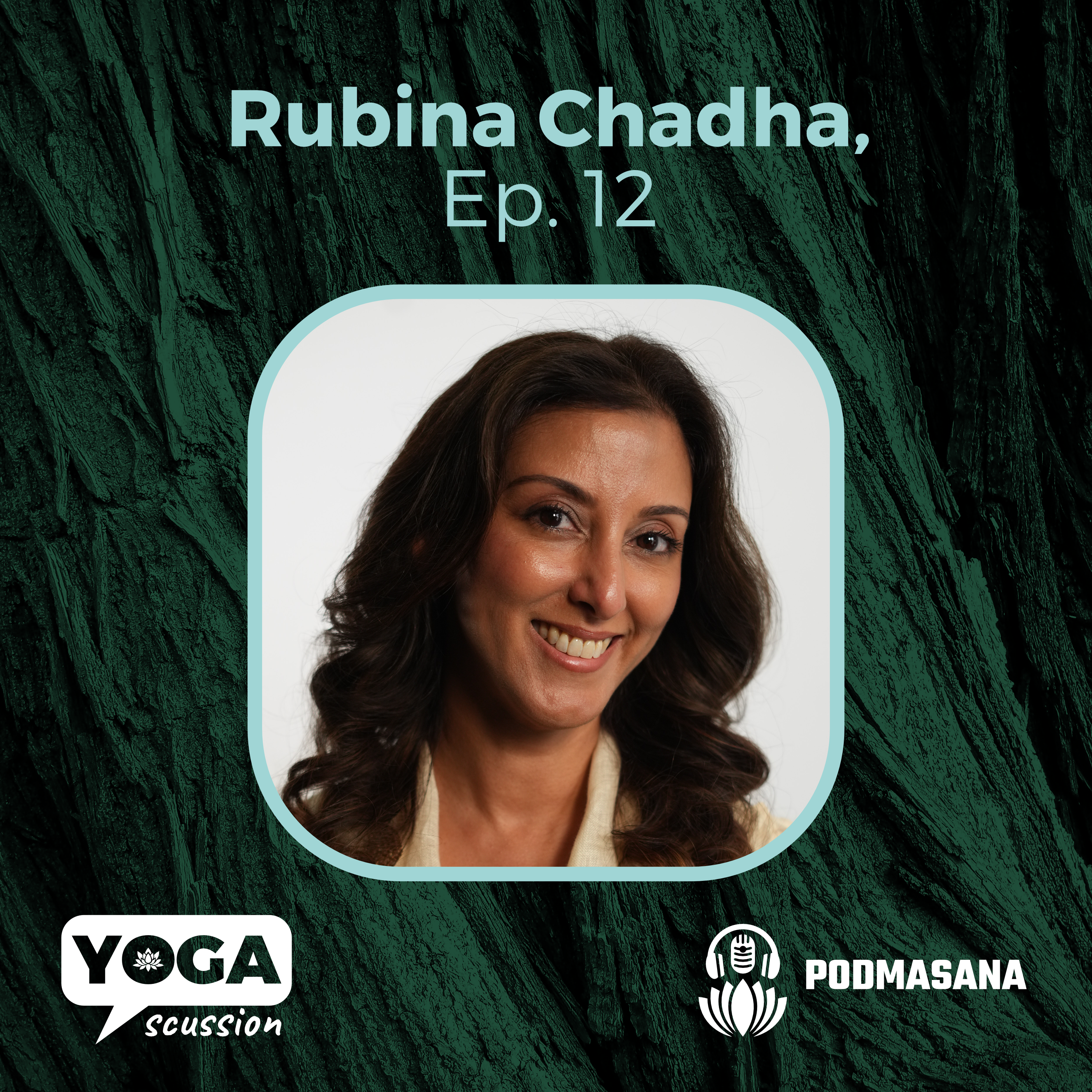
Brendon today we have Rubina Chadha. She's a trauma-informed educator, mindfulness expert, and a creative mentor. She's got a fine arts degree from UCLA. She's a certified life coach, a registered yoga instructor, and a breath work facilitator. And she's gonna be talking to us today.
about her yoga journey and how it brought her to create Inner Design, which is a business that she runs that helps people kind of get in touch with themselves in a creative way through these awesome yoga technologies or yoga practices like breath work, meditation, and yoga. So to have her
Brendon Orr (01:04)
an impressive
Rubina (01:06)
Hi there.
Brendon Orr (01:08)
Hi, Rubina.
Gina Clingerman (01:08)
Hi, Robina, how are you?
Rubina (01:12)
I am doing well, how are you guys?
Brendon Orr (01:14)
We're doing good.
Gina Clingerman (01:14)
Great.
Rubina (01:17)
me too.
Gina Clingerman (01:18)
Great. Welcome to YogaScussions. We were wondering if you could give us a little introduction for us and our listeners of yourself and kind of what you're doing.
Rubina (01:30)
So, ⁓ that's a big question.
Gina Clingerman (01:33)
I realize that as I say that it's
Brendon Orr (01:33)
Yeah, weird
Gina Clingerman (01:35)
like, gosh.
Brendon Orr (01:36)
There was a long list,
so we can start anywhere.
Rubina (01:39)
It's a long list. It's a long list.
And I apologize that it's so long, but also I think from the perspective of yoga, I'll give you all of it. So, was born and raised right here outside of LA. And I think that that had a lot of impact for me having grown up in an East Indian household of, you know, immigrant family, but born and raised here and just.
That merging of the culture was really what brought me on my my yoga journey. And I founded my company, Inner Design, to bring multidisciplinary, to bring mindfulness, creativity, these principles of like kind of East meets West and bring it to corporate settings, corporate settings that were particularly being Los Angeles and the entertainment industry where people are dealing with burnout. So.
Brendon Orr (02:19)
Mm.
Rubina (02:30)
the programs that I offer did begin in the educational institutions and have worked their way to, you know, all kinds of different, ⁓
different levels for CEOs, founders, leaders, and they all have the basic principle, yogic principles is basically what it is. It's yogic principles that we can apply to ourselves today. And so to me, yoga is more than a practice, just like mindfulness is also more than a practice. It's a way of living. It's a way of being. It's not mindset. It's really integrating the values and the principles.
I think that's how I could introduce myself. So that's who I am, Rubina Chadda, Inner Design.
Brendon Orr (03:07)
Yeah.
Gina Clingerman (03:07)
you
Brendon Orr (03:10)
Yeah.
Yeah. No, thank you for that. And, you know, I'm curious ⁓ in your line of work, you know, being based in LA, what does it look like ⁓ in that ⁓ industry? ⁓ Because of course there was the labor stoppage and right now the industries are experiencing a lot of change. Right. So I'm curious if you've seen anything shift on your end.
Rubina (03:32)
Yes, yes, that big change is that the elephant in the room, the AI stuff, people really looking and wondering, being fearful of creative jobs and positions where, you know, they're giving their heart and soul and is that going to be replaced by machinery now? The way that my perspective is that tasks may be replaced or the burdens that people feel and get stressed out with in this particular industry.
or something that will keep having that ebb and flow, the concept of the basic principle of...
conceptualizing creativity and design principles and design thinking, that's always going to be a human factor. So that's what I see and that's really where I lead from and I guide people from because I think that realizing, okay, I'm still human and I have these ways of expression, we'll call it, right? Because I don't think it's just a talent or it's a gift that's only to certain people. I think that we all are born.
intrinsically creative and just what we do with it and how we express it and how we explore it or you depending on how limited we have been in our upbringing it's you know education, family situations and stuff like that but I think that having you know access to the creative energy that is bringing us into every single thing in our life, how we make decisions
is intrinsically human and yoga, mindfulness, meditation, breath work, all of these practices lead us to those principles of being human and guide us back into away from that mental stress.
and moving towards the well-being and mindful and sustainable future of humanity is how I look at it. I mindfulness is sustainability. They work together and we need to just kind of align. I think that, you know, yogic principles really help us to align to that, which we all are, which are, you know, very human.
Brendon Orr (05:38)
Mm.
Gina Clingerman (05:38)
Yeah. Can you I see that you have an art degree as well. So art is like a real vein that runs through your life. And I read a bunch of the interviews with you that I could find online and used to run like an educational company. Is that right? And you came to this kind of point in your life where you were like, this isn't serving me.
Rubina (05:47)
Yeah.
Yes, yes.
Gina Clingerman (06:03)
and you had this moment of kind of like, I'm burnt out. I don't know what to do. And so you kind of, from what I gathered, you came back into sort of a relationship with your yoga and your meditation and breath work and created inner design out of that. And could you speak to a little bit about how, like how that happened for you and how yoga kind of
stripped things back for you or all of these practices together kind of stripped things back to where you could like see yourself again. Because I think a lot of us, yoga teachers included, we kind of come into this as an idea of like, want to help people, but we sometimes lose ourselves in that role. And then sometimes we kind of lose track of our own practice and we're like, what am I doing? So yeah, I'm really curious about that for you.
Rubina (06:56)
Yes, yes. So yes, I had two different careers. So I started off in the creative field, which as a commercial artist for me, that's where it was really, I would say it, it was really cutthroat. It was fast paced, it was in the industry and high demand. And I was like, oh, I can't do this anymore because the creative drive gets stifled.
with all the pressures, with all the fast and the noise, and then it was going back to get a degree in education and run a family business, which education is great. I really found a beautiful drive to be able to help people, lead people, guide them, teach them things at all levels. So I worked from very small kids, early childhood education, all the way up to college, still teaching high school and college classes. And...
That also was not the full answer for me. It was like, okay, now I left my creative expression to come and do this other thing. I think it wasn't the what that I was doing. It was the how. It was that disconnect of, yes, it's these practices that aligned me to myself. And then I had that discovery that, we all need this. Educators need this. It's a burnout field. Creatives need this because they feel disconnected from themselves.
needs this, yogic practices, and to understand what these principles are. And so re-looking at those experiences that I had for my different degrees and my different work experience actually gave me the access to it by taking, going back to my yogic journey, which is basically something I was raised on. But you know, we all kind of know the things we should be doing and have them and maybe we just kind of push them aside like, not now, I'm too busy.
Brendon Orr (08:42)
Yeah.
Gina Clingerman (08:42)
Yeah.
Rubina (08:42)
It's a
noisy world right now, I can't hear it. So that was part of it for me. And I still think and I still feel that yoga.
Brendon Orr (08:45)
Yeah.
Rubina (08:51)
is not and was not an addition, it was a removal of the excess. It was that time to just pause and step away and say, okay, this is all going on now. What's really going on like within? That was the entry point for me. was like, okay, how do I get back to my breath and find out what's going on within? And then turning that with, like you said, my degree. Those are my talents, my skills. These are my practices that I can serve with. But until I went back
to myself through my yogic journey again, I couldn't see it. I couldn't find it. I was too close to it to find the solution.
Brendon Orr (09:29)
Mmm, and I'm touched. Rabina, you know as someone who From my early days. I've always kind of felt this creative pull, you know, it's it's just been there Can you maybe speak a little bit to the role that a yoga practice or maybe even specifically? pranayama or breath work might have in terms of maintaining or sparking that creative ⁓ spark or passion or drive
Rubina (09:57)
Yes, yeah, I find it, like two main parts. When you asked me that, I thought, yes, it's awareness. It's basically coming back to awareness gives us that access to, okay, there's some creative, some stirring, some excitement of expression. But really, it's rest. It's so basic, it's rest. And I don't mean like, let's get eight hours of sleep. Yes, get eight hours of sleep. And yes, eat correctly, do all of those things. But...
Gina Clingerman (10:14)
you
Rubina (10:22)
as you know, know, meditation, breath work.
yoga, all of that gives us access to a rest that is quiet and still without having to go and lie down in the bed or take a nap, which sometimes that can make you also kind of lazy and tired, which, you know, those are also yoga principles, like too much of one thing or the other can throw us off. And so I think what it really is for me, what's really worked and helped is yoga as asana, as we know it, right? Physical postures, moving through, moving the body, whatever that is.
You
can be a runner and I will still call this yoga because I used to run, I've run marathons in my younger years and that was very much yoga and it was breath work. All of those things were happening. As long as you're moving the body and getting access to breath and some awareness of this breath and that breath is helping you regulate in any physical activity, whatever sport or whatever practice it is.
I'll call that yoga. so that having the physical expression, tying it in with the breath, knowing how the breath is helping you move into this, you know, these physical experiences actually brings a deeper sense of meditation. It actually gives more of the access to the quiet mind, the stillness, because I don't think until I understood that
could I meditate? Thinking, I'll get up in the morning, I'll meditate. And there's just that little bit of slowness. we're having all the different Ayurvedic principles. You're having Vata and Kaffa, and you're having all these different times. And your body is going through these things.
learning to align with them and say, this is a time where, yeah, I might feel lazy, but actually, if I move a little and I stretch my body and I start to have breath work, then I can access the entry point to my deeper meditation while it's quiet and dark still out, you know, or people aren't bothering me yet. So that combination of all of them together and really knowing, think the awareness of really knowing, yes, I want to embark on this. It's not a journey that's separate. So I won't say embark on this journey.
but it's part of the human journey, I think.
Brendon Orr (12:32)
And like awareness, you know, I'd be curious to know what both of you think about this, but awareness for me comes from a place of pause rather than play. And we live in a society that's all about play, pressing play. Maybe there should be a big pause overlay button on top of every, you know, play button, and maybe that might help people either in creative fields or in society writ large. So what are the two do you think?
Gina Clingerman (12:56)
you
Rubina (12:58)
Yeah.
Gina Clingerman (13:00)
I think, I think you're right. I also think awareness comes from this idea of dropping out of expectation. You know, what what do other people expect of me? What do I expect of me? What do I expect of me based on what other people expect of me? Or what do I expect expect of me based on the culture I was raised in the way that our society talks about whatever right? Like, as you were speaking, Robina about
All of that, I felt this sense of dropping in and like, our minds are constantly busy. They're constantly, you know, we have phones and computers and we have career goals and family and all this stuff in our brain is constantly doing a little schedule in its head of how to get us ahead. And sometimes that just needs to stop. And so I do agree with you, Brendon, awareness is pause.
but it's also like dropping out of expectation and just like showing up in your body the way it is now, not the way you want it to be, not the way you wish it would be, not the way it was 20 years ago. Like here's my 45 year old body now, here's how it feels now. And maybe dropping out of these other things like expectation and longing and whatever and trying to just be.
a person who breathes, a body who breathes right now.
That's what I'm practicing as a 45 year old woman. Yeah. What do you think, Rabina?
Brendon Orr (14:31)
Yeah.
Rubina (14:33)
Yes, yes, and I love all of that. And I'm turning 50 in a couple of months. So I feel like, yes, I'm practicing different things than even five years ago, but definitely different things than 10 years ago and longer back. when I think of first, Brendon, when you were saying.
Brendon Orr (14:40)
Nice.
Rubina (14:51)
play and pause, was thinking play, like playfulness, and I thought, that's creativity. But then I realized what you meant, like the play button of like performance and being on. And that's something definitely that I teach creatives, you know, we go into a creative field if that's where we are, or creative expression in general, not to be about performance or.
outcome or output, but we're in the society where everything is rewarded to have outcome and output. That's how we're paid, right? So that becomes really confusing. think that's what was really hard for me as a creative in a creative field was that bringing that creative side of it that wants to emerge, but then also, you know, trying to monetize that and or being in the society where it's being monetized and it's being judged that way. And so I think of that pause also to be the awareness
also to be free of judgment. Listen, I get it. We can't judge the judgment, right? And the mind is really there to judge. It's one of the factors of what the mind does. It's one of its functions. And so taking a pause from that and then just, for me, it's always been that process-oriented. Process-oriented gets me away from that.
you know, having to be in the performance output side of it, of just saying, okay, this is, I'm in the process of creativity, I'm in the process of expression, and whatever comes out of it, garbage or not, it's good or not, bad or not, whatever it is, it's just part of this experience. And I think that yoga really taught me that because you're on the mat and some days, ⁓ wow, look at you doing this heads down and awesome things in the very next day or the prior day, maybe that wasn't available. And so,
I look at that from more of a trauma informed lens of acceptance, free from judgment and being, you know, being with, this is what it is. This is what I'm showing up with on the mat. This is what I'm showing up when I leave the mat.
Brendon Orr (16:40)
Hmm.
Rubina (16:50)
And I'm on the road. This is what I'm showing up with. If I'm an artist and I'm working in a studio, this is what I'm showing up with and getting really, you know, awareness is a broad umbrella of it, but just getting kind of aligned to that. it does take practice because we are so often walking around like we are just this part that's thinking and seeing and tasting and all the senses, hearing all of that stuff. And we get disembodied from the rest of our functionality, the whole being, which gives us a lot of
senses, we know that, right? Through the nervous system that's moving through our body. And I think these ancient practices actually knew those things. That's where the breath work was to help regulate vagal tone. you know, regulation was this whole experience. And yeah, I know right now people are like, nervous system regulation. Yes, I've been teaching this for a while. And I know it's a hot topic.
Brendon Orr (17:22)
Mm.
Rubina (17:45)
And it's important, but also sometimes just being with it and knowing, ⁓ I'm in fight or flight. OK. As soon as you recognize that, guess what? You're on your way out of that, expanding your window of tolerance and saying, yeah, there's something there. I can move through it ⁓ simply by the distilled version of it, which is awareness. Right.
Brendon Orr (18:02)
Mm, mm, mm.
Gina Clingerman (18:08)
think sometimes we moralize this idea of not being, being regulated, being, you know, having your nervous system be regulated or having it not be regulated, that there's some kind of failure and dysregulation. And it's like, no, that's a response. That's an organism's response to stimuli in the environment. And unfortunately, our environment is pretty stimulating right now. You know, like anyone who is
totally regulated, I'm gonna be like, yeah, you are bypassing. You are bypassing what's happening in your body and all around you because we can't stay regulated. So I love that you say, I'm just so grateful that you say like, noticing when you're in fight or flight or fawn or freeze is already expanding, because it is. And it's okay to have those reactions. Like it's so human.
Rubina (18:58)
yes, absolutely.
Brendon Orr (19:00)
Yeah. And I wanted to also circle back, Rubina, you had mentioned trauma earlier and you know, there's probably some, yoga teachers who are listening to this podcast. And so you often have spoken about, the creative environments that you've been in or the creative professionals that you might be working with and where, in those environments or those people, there's a desire to be deeply seen and to feel safe.
a principle that's kind of central to trauma-informed yoga teaching. For any of the yoga teachers who may be listening to this, maybe who are trying to move beyond just cueing poses into maybe holding space for some type of emotional release or regulation, do you have like maybe one practical or actionable way that they can begin to maybe weave like the nervous system awareness into
a vinyasa or hatha class without completely overhauling their approach to teaching or a sequence that they might have in mind.
Rubina (20:01)
Yes, I do. Absolutely. I actually train trauma-informed yoga and I won't say it's just one practice, but I think the first and main principle and practice is the teacher is the practitioner first. That's the big thing. It's, I? Yeah. And then that whole thing again, am I showing up on the mat? not.
totally perfect this time and accepting that and saying, okay, do I have access to today? We don't always have to be, I think that's the hardest part is we feel we should be perfect. We should be performing each pose in the ideal way so that our students can mimic it or see it, right? But that's not what we're doing here. It's not just, this is not a performance, right? So it's an experience. And once we are practicing awareness,
not claiming it like from an enlightened place, claiming it as practice, right? The practice is never perfect. We hear that, practice, but it's actually not perfect. And returning ourselves to that beginner mind, know, yoga is an unfolding. It's not an achievement, but it has become a blood sport right here in the West. So this understanding of, hey, these practices are ancient and they were really
not meant to have this perfect performance aspect. Yeah, okay, maybe people enjoyed that. And sure, we all feel great when we're able to do something and yay, we did it, but it's that journey, right? So that's the first thing I would say is really getting clear on that. And that takes time and it takes choice and that choice you have access to every time.
You may not have access to every time having a perfect class, but holding space to me was really vague. And I was thinking, how do I teach holding space? You know, when you said that and I thought, yeah, I've said it lots of times. And sometimes people, I'm like, what does it actually mean when you distill it down? What does holding space mean? And I think personally, it's about that.
our practice first. It's about me being as aligned as I can be and sometimes we're not and giving ourselves grace and saying, okay, I'm not going to judge myself. I'm not that aligned. Maybe this is not a great day for me to teach or I'm going to teach really mildly because I'm not going to try and make all those achievements and perform and outcome and all of that stuff. I'm just going to be gentle for myself and maybe that showing up that way for myself opens the opportunity to
someone else who's practicing on the mat in the room with me and they feel it vibrationally, right? We are all energetic. We know that we're sharing space. So when I'm
Brendon Orr (22:38)
Hmm.
Rubina (22:43)
sharing that kind of space for myself, I'm giving myself the honor. I'm also allowing others the honor for that. And I think that it takes a lot of awareness to practice trauma-informed yoga. It's really reading the room and getting out of the mind of like, okay, this flow goes into that and now I'm cueing left hand and right leg and it has to come really embodied.
It comes with time, with intention, with practice. And even if you make a mistake, it's no right or wrong. It's just getting up again and allowing yourself to be the student and saying.
Okay, I'm going to try this work really great. Great. I'm going to try this tomorrow a little more this way. It'll unfold. mean, everyone who's trained in yoga has so much discipline and background and understanding of the sutras and where we're coming from. So I think that intention is already there.
Brendon Orr (23:25)
Mmm.
Yeah. Do you know there's two bumper stickers? I think from what Rubina just said, you know, like the, value of like the collective embodiment and also yoga has become a blood sport.
Gina Clingerman (23:42)
You
Yeah, yeah. My retirement plan is my retirement plan is to make good bumper stickers.
Rubina (23:50)
⁓ I can't claim that one. I can't claim that one.
Brendon Orr (23:54)
You
You
Rubina (24:00)
Yes, that was Zarna Garg. She's a great comedian and she said that yoga has turned into a blood sport in the West. We're rushing with our yoga mats and you're rushing, rushing and then she says, if you're rushing to yoga, you're doing it wrong.
Brendon Orr (24:15)
I think my wife has shared that video clip with me now that I hear it again. Yeah, that's a funny one for sure. That's a funny one.
Rubina (24:18)
Yes.
Gina Clingerman (24:25)
What were some of the inner hurdles that you had to navigate while you were developing kind of birthing the idea of inner design and then like getting it up on its feet and then.
starting out and doing all of that, you know, the development and... So what were some of those inner hurdles that you had to work your way through and how did you work your way through them?
Rubina (24:47)
⁓ I have been very far from having it perfect. Although, thank you. take the compliment. It has been quite a long journey and definitely I faced a lot of hurdles, personal hurdles, family life, career path, a lot of different hurdles of trying, of getting to finally get where it clicks in and I feel in sync and aligned. And I say, my gosh, this is my soul wanted me to do. And the universe is really
rewarding me for that. So I feel that's, if I can be of inspiration to anyone, when you find your soul aligned and you're in that flow, it will come like that's my hope and blessing for everybody as they embark on whatever journeys they are, but especially through this path.
with yoga and I think that has been my path that has taught me the steadiness and the ease and the places to kind of like disconnect like, okay, this is too much, you know, efforting or this is not pushing or this is not happening and this is not maybe meant to be and kind of learning to go with that and let go, you know, the wisdom of all over and, you know, I think of Confucius and Zen and Buddhism, everything has those.
qualities, they all tell us the same message. And just getting aligned with that and trusting into it. I know it sounds woo and it's like way out there. But what we're doing here with yoga is building strength and that strength is happening on a subtle level, not just physical and not just energetic, not just your vagal tone when we talk about, right?
it's strengthening our capacity to respond. And when I say to respond in life, I mean that on different levels, that life is always happening around us, not always to us. What happens, the to us part is us.
getting involved either sometimes latching on hooks unnecessarily, but also responding to like, ⁓ maybe this is an opportunity that just came in front of me and I didn't see that and now I can kind of go and find that flow. And instead of being in collapse or overreact,
becoming presence, embodying that, not theoretically saying, I want to be present, or I have to do something to get present. Like just that moment, like realizing now I'm presence and that's embodied. It's not an efforting thing, but yes, a lot of things can align with it. Of course, good sleep, good food, all of these parts of life, when you don't have all those, feel so unaligned, it's hard to become present, right? Through physical pain.
through emotional pain, all of those aspects. So I feel like it's yoga that offers that framework.
Brendon Orr (27:40)
Hmm.
Rubina (27:40)
of
finding what that is, whatever hurdles there are, knowing that, okay, besides those philosophical concepts of like, whatever you're given, you're equipped to handle it, sometimes those things, they're just, you're me, right? And if we want it to become embodied, really looking into what does that mean, this is the framework, okay, this I'm able to do, let me do what I'm able to do, let me respond in the way that I'm able to, let me get
myself aligned getting into my Dharma getting into that you know life that I'm living and I would say that's it I would say really that's it coming through that mindful space
Brendon Orr (28:23)
Yeah, and so Gina and I have had conversations in the past with other guests and joking about how, you know, were we, have we been the people who have been kind of nagging others to do yoga and experience the benefits of yoga? Or were we the ones being nagged, maybe both at different points in life? I'm really curious, Rubin, and I imagine listeners are too, having grown up with your cultural background, was that,
Like embodied at home, were you encouraged and or pressured to bring this into your life? Were you always cooperative? Did this just come effortlessly, to you? Was there a strong connection there? I would just be curious maybe like to hear maybe those early days or early experiences with your yoga journey.
Rubina (29:09)
That is such a great question. Nobody has asked me that. You know, you're right. I was nagged. I was nagged. And that's probably why, you know, in my youth, it was like, you got to do this. I got to meditate. my gosh. You know, this is what we're doing. those parts of it became, you know, we all are that rebellious teenager of like, no, not the thing my family.
telling me to do let me go the opposite way and so definitely people are like oh yeah so you just had yoga and breath work and meditation all your life and that's why you come no i ran away from it absolutely honestly i kind of was like oh my gosh this is all the stuff that happens in my home and my family thinks it's going to solve my problems it's not right that rebellious and youth and wanting to go out and experience life and then going out there and finding the missing thing was back at home on my mat you
know
that was the thing and I was equipped with it and so that it did kind of line up in sync and click in like yeah I have this you know.
Gina Clingerman (30:02)
you
Rubina (30:09)
I think it's kind of like when you go to the grocery store and you have this long list to make a very complex recipe and you have all these ingredients and instead of going and buying all the stuff that's out there, you start to think, well, I think I have this at home. I might have that. And it was that experience of first being out there in the world and being like, okay, these are all the ingredients that the world is helping me to make this, whatever the cake that I want.
Brendon Orr (30:26)
Yeah.
Rubina (30:36)
some of those missing ingredients I couldn't find outside of myself. And it was that inner journey of coming back to it. And so I don't love to push it onto people because of that very thing. I usually wait and I'm always asked, people will always stop and say, what are you doing? I'm seeing you, what are you doing? How is your either business success happening? How is your family life? Even though
People may know my personal life and it has a lot of complexity. How are you looking so young at your age? How do you smile and you're happy? And I always give them the answer. And I say, I have a secret. It's this. It's this. It's my practices. It's yoga. It's breath work. It's meditation. This is keeping me alive. Imagine what my life would look like if I didn't have these aspects. So even in those challenges, like Gina was asking, like even in those hard times, yeah, I'm human. Do I fall apart?
sure absolutely there's times I feel I'm crumbling and I just know I gotta just keep doing this I'll get through it this will pass all of those things all of those philosophical things but the practice practice the going back that going you know into something that can give me that discipline gives me the reward is what it is
Brendon Orr (31:52)
I like that. And so, Rubina, I was reading, like Gina I was reading a couple of articles, about you or, know, other interviews with you. And, one thing I was taken by as a fan of what today is referred to as coherence breathing, right? that, you know, 5.5 or five, five method.
⁓ so you outlined, like a daily, routine for breath work, to try and balance, ⁓ cortisol, rhythms or levels. And you started with, ⁓ coherence breathing in the morning. ⁓ I believe it was box breathing kind of a middle of the day and just letting out some sighs in the afternoon. And I, haven't done this myself, but I was thinking about giving it a shot.
and then I can always report back to you. But I was wondering if you could maybe share with listeners how you kind of came to this, you know, selection and putting it together and why certain times a day could maybe speak to your process a little bit.
Rubina (32:52)
Yeah, absolutely. So that's basically my inner design method. I think that in the start,
It's definitely a rhythm that you can say morning, afternoon, evening, just so that you start getting your body adjusted to what's happening, right? Ayurvedically, we know that the day has different rhythms, right? Like we were talking about, like I was saying, there's vata, pitta, and kapha, and all of these are happening to our body. Actually, they're happening, and that's partly why we have different emotions and different levels of energy throughout the day. Traditional Chinese medicine also refers to these kind of things of what's happening, what's going on with our organs.
system mostly in the night, but it does go through the full 24-hour clock. so looking at that and saying what, I guess if I'll say it, what results am I looking for or I'm in need for at the certain times of the day.
This is a starting benchmark to start practicing so that breathwork starts to come into the body. You know, we're only using about a third of our lung capacity. So restricted and so just starting to expand that in a gentle way of saying these certain times in the day. And that way also trickling it out instead of there was a time I would practice only breathwork in the morning. And by three p.m. I was like, what's happening? know, so just realizing that I need maybe shorter amounts, little amounts, like we say in mindfulness, little but often. Right.
and I need them to be throughout the day, started to find these were good results. But I also will say, maybe this is controversial, but like in any yoga practice or any practice, mindfully, you're going to have to listen to your body and say, you know what, understanding of this breath work.
it gives me energy. that breath work, gives me relaxation. this, so now I'm following my body rhythm instead of the clock of the day and saying, although this is the time I usually have a lot of energy, it's not happening right now or today, it seems different. Let me do some energetic breath work.
and help myself along. So again, it goes back to the thing we started with. It's the awareness, the understanding of the whole system. And there is a method to it. There is a method. And I do have trainings on this. In fact, I just finished putting together ways to sign up for this online on my website. So that'll be available probably by the time.
people are hearing this. And I will reach out and teach people one to one because I believe in trauma informed care where I need to see what is happening to you and what.
you know, results you're getting, what responses your body's having, and maybe to tweak it and to customize it because I can't say it'll just be one. But those are the basic ones that I can say safely you can access at any time of the day and those are the ones I would say that probably are going to give you those results which we usually need in the average day, you know. But it is personalized, it's definitely personalized and it's important to go on a journey of breath work and understand.
what's happening in the body and what energy you can access by modulating your breath.
Brendon Orr (35:52)
Yeah, that's a great answer. And, ⁓ I appreciated the personalized aspect of it because, know, I, I really find my own personal Pranayama groove, I suppose, like with coherence, you know, breathing, you know, maybe it's one of those, I mean, it's called coherence breathing now, but maybe it's one of those things that's really stood the test of time, but I really appreciated the personalization. And it's also kind of a nod to the experimental and experiential nature of this ancient practice.
you know, in terms of things being experimented with and, you know, certain types of breathing techniques may work for certain situations, certain people, certain times of day may be better than ⁓ others. So it's all very fascinating, right?
Gina Clingerman (36:21)
you
Rubina (36:36)
Yes, yes, in certain life phases, you know, this phase of my life, maybe I need more of this, I need more energizing, I need, I have a lot of activity, or I need more coping or whatever it is, right? So just knowing that maybe breath work I was practicing five years ago was great, it was addressing the stuff that my lifestyle had at that time and today, something needs to kind of like, you know, find a different pattern or a different way that might serve me better at this time.
Gina Clingerman (36:36)
And I.
Brendon Orr (37:02)
Hmm.
Gina Clingerman (37:03)
I love that under the surface, there's just always this thread of awareness, right? It's like, do try it and see what it's like for you. Cause I think there's so many ways that we as humans can be like, this is the only way, like do this breath work and you will be saved or come to yoga and all your problems will fall away and you'll just be like this perfect human. And the beauty is, is that, you know, we just,
we need to show up in our bodies with this subtle gentle awareness of like, how is this for me now? What is this pose like in my body? How does this asana land? How does this breath land? And I think the beauty of that, which I love that you're so awareness focused, but in such a gentle way is that it builds trust and relationship with our bodies again, especially from like a trauma.
perspective, someone who's either had physical or just a lot of stuff happen in their lives. Sometimes the body doesn't feel safe and learning how to breathe safely, learning how to like show up and just watch and be present with your own body. It builds that trust again that like, ⁓ this is me. This is a place where I get to, to be. This is a place where I am. This is who I am and it's okay. Yeah. It's really beautiful.
Brendon Orr (38:20)
Mm. Mm.
Rubina, I'm wondering, earlier we were talking about those annoying stories or whether we were being annoyed or encouraging. Is there maybe an example of someone you've maybe encouraged to adopt a yoga practice that maybe really needed it in your own personal life? Of course, you don't need to name anyone specific, but I think maybe we've all, for those of us who have been in the yoga space, if you want to call it that, for a long period of time, at some point,
you are in the situation where you feel like the most authentic thing to do is maybe say, Hey, you know, this really worked for me. You know, maybe, you know, give it a shot or please do give it a shot. Could you maybe walk us through, an experience like that? If you had one.
Rubina (39:09)
Yeah, absolutely. So I think it comes from attachment. I'll say it that way first because that person is my son who's now 18 years old, moved away to college. And I learned about a lot of my yoga discovery in these years raising him. And so that parenting journey of how much do I teach? How much do I, the same thing, looking back at how it was my family, like, okay, this is being put on me. How do I?
make this available to my most attached person, right? The person that I love and I'm raising and all of those like, right? So just looking at that from a spiritual aspect of like, okay, this attachment, like, can I give it and let it go? It was really hard to your own child, right? So definitely.
Brendon Orr (39:51)
Hmm.
Rubina (39:55)
even at this point in these 18 years journey, right? It's a long time. I know there might be parents listening to this who have littles and I would just say I always did it openly and talk about it and showed how much it helped.
and then did guide and say, really want you to learn this. I really want you to try it. And ⁓ if you hate it, that's okay. And now at this point, there's times where I will hear him saying, yes, I know that meditation was so good after I did that breath work and I really needed that rest. It really went deep. Like, yay, there's a little mom inside of me clapping, but I'm quietly like on the surface like.
Okay, it's good to hear her inside me. I'm doing the happy dance. So I think that's what it is. I think that when we share something that we love and are identified with and we know it's doing so good for us and it's been such a great experience, we want those that are close to us that we feel attached to.
Brendon Orr (40:39)
You
Rubina (40:53)
to experience that and that makes this kind of this tension of the situation around. It's not like my parents had ill intentions. They loved us. They wanted us to have this greatness, right? But the way of things and that way is again if we just go back to that thread of having discernment through the awareness, having clarity and having like how would that feel if I was on the other side and then just I feel like for me I've just always waited for people to ask me about it. I just wait. They just know.
⁓
my gosh, you're looking great. my gosh, you were sick, but everyone got the flu for a week and you in two days were up and buzzing around. It comes through all these different sides because the yogic principles are addressing us all around. The physical, the mental, the emotional, all of this we're regulating. And so yes, it's a beautiful thing to share. And I really have honestly felt it's been the best for me to just.
The more I kept it a secret or quiet, the more people wanted to know about it. And that really gave them their own journey because it really was about handing it over to them. I want this journey because it's not going to benefit me. I want them to have the benefit in the journey. So letting go of me having to say it, maybe they'll hear it from someone else or maybe it'll be the 10th time that somebody talks about yoga. They'll be like, yeah, I think Rubina said that a long time ago. OK, maybe I'll try it now. So just kind of like.
again, just being in that awareness, being discerning about it. it's beyond, it's beyond the practice. It really is beyond the practice. And I feel that everybody, like I said, is practicing yoga in one way or the other. They may just be calling it something different.
Brendon Orr (42:19)
Hmm.
Mm, mm, mm.
Gina Clingerman (42:34)
Yeah,
yeah, I think that often, I think that often is that there's a lot of people doing yoga, but they don't know that they're doing it. And we also have these boxes we like to put things in all the time, like, this is running, like I have a book called Running Is My Therapy, and it's got a lot of breathing practices in it that you do. And it's got a lot of principles about
you know, therapy principles that you can apply during a running session. And it's like, everything's yoga. It is. If we're bringing the awareness to it, I think.
Brendon Orr (43:06)
Hmm.
Gina Clingerman (43:07)
Yeah.
Brendon Orr (43:09)
Yeah. And I, you know, ⁓ I believe Rubina, were also talking about running. I'm wondering if your running experiences because of your cultural, background, and upbringing, were exposed to yoga at a young age and that maybe helped you running. think about my running days and I understood it with, there was a relationship between breath and movement, but I don't think I was really.
It was more about observing things as two separate occurrences rather than like a connective, you know, experience. And I, to this day, I think that, man, I wonder if those, if I would have maybe won a few more medals, not that, you know, when I look back, I think all of this is quite silly, right? You know, I've been trying to win medals and everything, but I wonder if I would have won a few more medals if I would have been, you know, making that connection. Because I think
Gina Clingerman (43:53)
you
Brendon Orr (44:02)
You know, a wise person once told me that yoga isn't complicated. It's ABC, awareness, breath, and connection to those two things, right?
Rubina (44:13)
I love that ABC, yes, absolutely. My running experience to answer you on that was about 25 years ago. So I was not actively practicing yoga as much. I had practiced yoga, but I was going on this running journey and I was gonna run these marathons and this was, I was training for it and all that stuff.
And as I got into these longer runs, I noticed a couple of things. Again, it might be that whole ABC. I noticed my breath. I was like, know, mile 10 or mile 12. And all I could hear was like, could feel my heart just like pounding out of my chest.
but I could hear my breath so loud in my body and it was the body naturally does that runner's breath of like inhale twice, exhale long and you're just coping, right? It's kind of like your body is coping with like how much pressure is being put on it. And I remember noticing that just like, my gosh, am I doing this breath like purposely? mean.
Of course, 25 years ago, there wasn't like social media. There's no other distraction. I'm just out there running for miles and miles or running on a treadmill for miles and miles. And I thought, am I doing this on purpose? Is this breath actually just happening? So that was again.
aligning myself into like that awareness of what was happening and at some point, know, I think it was probably after mile 12, there was a lot of pain, but you know, a marathon is 26.2 miles. I was only halfway, not even halfway and I wanted to get to the goal. Like you said, I wanted the award. I wanted to reach that goal as I left as a marker for myself and so I began to integrate yoga and it was yoga at the gym of all places. I think that's the first time I really started doing yoga at the gym and it's a fabulous yoga instructor.
was definitely very aware, very aligned, very present. She probably didn't know she was practicing trauma informed care at that moment. for me, was in pain, I starting to have pain and I felt...
⁓ I just, I don't know what made me think that but internally that something that was probably bred into me knew this is my answer. I have to balance the amount of running with yoga and let me get to this class twice a week. And there was a lot of relief, right? Because you're pounding yourself on that concrete, you're pounding yourself when you're running that much and then the body wants to have these elongation and stretching and just remember thinking, my gosh, what a relief it would be. And then re-energized and ready to get back out there on
the pavement. ⁓
Brendon Orr (46:39)
Hmm.
Rubina (46:41)
I don't think I was prescribed it. know, nobody said go. But internally, there was this yearning, there was this longing for it. My mom would always say, you were born a yogi, you know, she's like, you were just a natural born yogi. You were, you were a yogi in the grocery store, you would walk around behind me as I was pushing the cart and getting vegetables and you would just pick up veggies and eat them raw, know, snap peas, you know, like back in those days, all the veggies were just out and open, not plastically prepared, right? So just you would just start eating stuff.
Gina Clingerman (46:51)
Mm-hmm.
Brendon Orr (47:03)
You
Yeah.
Rubina (47:10)
just it didn't matter. You're this like three year old walking through and I would cut vegetables and you would be eating okra raw or the ends of it that I was throwing away and she's just like your body just knew and I think I still would feel that like sometimes people will say do you crave anything like yes chocolate and apples randomly at different times not together but there's times I'm just like I just need an apple and then my body's probably telling me you need this fiber you need the glucose you need to get the natural
Brendon Orr (47:13)
You ⁓
Huh?
Rubina (47:38)
whatever it is, but I love chocolate. I love my chocolate, get good quality chocolate and healthy chocolate. But ⁓ yeah, I think that there's, I've always listened to myself and there's always something that spoke to me. And I think we all have it. It's just maybe the environments have conditioned us to quiet those sounds that are speaking from our gut and we become disconnected from our instincts and.
Brendon Orr (47:44)
Yeah. Yeah.
Rubina (48:04)
at any phase and I'll say that any of you who hearing this and are feeling aligned to that, at any phase, at any stage in your life, you can go back to that. It's not lost forever. It just takes that stillness, that little bit of quietness, the alignment will come back and that is really, it's going to reveal itself in that stillness. So just having that opportunity, even if it's not through yoga, just kind of saying,
Is my body telling me something? And there's all kinds of, you know, signs and sounds that you can listen to your gut.
Brendon Orr (48:38)
Mm-hmm. Great. That's a great answer.
Gina Clingerman (48:40)
I'm really loving just listening to you. I feel, there's something about you that's very calming to me that just kind of makes me drop into myself. ⁓ What I was thinking.
Brendon Orr (48:48)
Yeah, she's the yoga mom that
I didn't have, but boy, that would have been great.
Gina Clingerman (48:53)
Yeah. Yeah,
yeah. Yeah, as you talk, I'm just like, ⁓ yeah, I feel so relaxed. What came up as you were saying all that is that really what the mission that you're doing now is really a mission of connecting people to their inner selves. And it's not really a question. It's just kind of a remark. like, wow, that's really beautiful work to
And to have such a peaceful demeanor to where people are like, like I'm just dropping in and being like, yeah, yeah, I can hang out, I can breathe and who I am is always available, is always right there. I think that's something that right now in the time that we are in that people just need. We need that message. We need to be able to know that we can come back to ourselves, whether we're practicing yoga or not.
I guess I do have a question now as I'm kind of rambling. I'm wondering as you were developing, as you were like coming into this kind of awareness of what you wanted to do, was it a light bulb moment or was it just kind of an evolution of like, I need to come back to myself. I see this as a place where I can offer this or was it an evolution of like, I'm kind of doing my own thing and then I, and then you get there.
Rubina (50:11)
It was kind of a mix, but I would say it this way, it was like a yearning. It was like this desire that was starting to burn inside of me and just like, my gosh, this is a framework of living in a right way that I can offer other people and I have such a desire to share it. So that first was that first part of it. But it was also feeling like called to it. So many people are out there, you know, and need help with their mental wellbeing and
this is offers such an avenue. The avenue really to me was that the yogic principles like you were just mentioning, it was about right relationship and we don't think of that. don't think of relationship as relating outwardly but there was relationship to the body first and then through that to others, to work, to purpose and it just started to you
remind me that meaning wasn't found in productivity, it was found in this alignment. And so that was something that I wanted to share, like yoga becoming integrated beyond the mat, off the mat.
and even in ordinary situations or actions creating that intention. And so for me, I'm really passionate to share it in the boardroom. I really love to share it in the boardroom when everyone's suited up and I'm suited up and we're not stretching our muscles in the yogic way, but we're getting this alignment, this understanding through a little breath access, through a little awareness and all of that. And then that hopefully goes with them back to their desk.
back to their homes, and then that ripple effect out into the world in these small ways. So a lot of times I don't call it yoga, I don't call it meditation, I won't call it breath work, I'll just say it's mindfulness or it's awareness and we're gonna do this. it's categorized under stress management, which fits perfectly into those kind of industries, mental wellbeing, that kind of a thing. And so to me, that's what it was. I felt like...
Yes, yoga is very mainstream today and meditation and breath work and these are easily accessible to everybody, but they're still not readily accepted everywhere, right? We think the mat, it belongs outside of the office. It doesn't go home with me to my family. And so that was really was the calling was just how can I start to
Gina Clingerman (52:22)
Yeah.
Rubina (52:31)
to trickle this and sprinkle this everywhere so that we realize it is fundamentally everywhere and bringing it with integrity, honoring its origins, not trying to steal what it was, but bringing those.
philosophical traditions with the deeper cultural roots of like what we're really doing here. To me, it was really important to teach with that integrity, acknowledging sometimes the lineage people will ask about it. And I will say these are ancient practices. These are all based on ancient practices. That modern science is now proving, are giving results. And so...
not diluting it for like trend appeal and also for me it was it still is remaining a student. It's about you know creating those spaces where you know autonomy matter that kind of a thing and learning and growing like you said right now the world is changing there's so much stuff that is can be overwhelming.
Gina Clingerman (53:12)
you
Rubina (53:24)
and is new and sometimes it's old or is unresolved or whatever it might be like relearning okay where does this fit where does yoga fit with this like how can I can bring this you know with like humility to bring us back to our humanity one practice at a time I guess is what I'll say right
Okay, this is Yoga Scussion
Gina Clingerman (53:47)
if you could answer in three words, what is yoga to
Rubina (53:51)
Yoga to me is life living through me.
Brendon Orr (53:57)
⁓ yeah. Yeah, that's touching. That's touching. Yeah. Thanks for being here. We really appreciate you sharing a yoga scussion with us and listeners. And yeah, it was just great to have you on.
Gina Clingerman (53:58)
That's really good. I gotta write that down.
Rubina (54:02)
Yeah.
Thank you. Thank you. was great to be here and share this discussion such a deep and meaningful way. Thank you.
Gina Clingerman (54:11)
Wow.
Thanks